
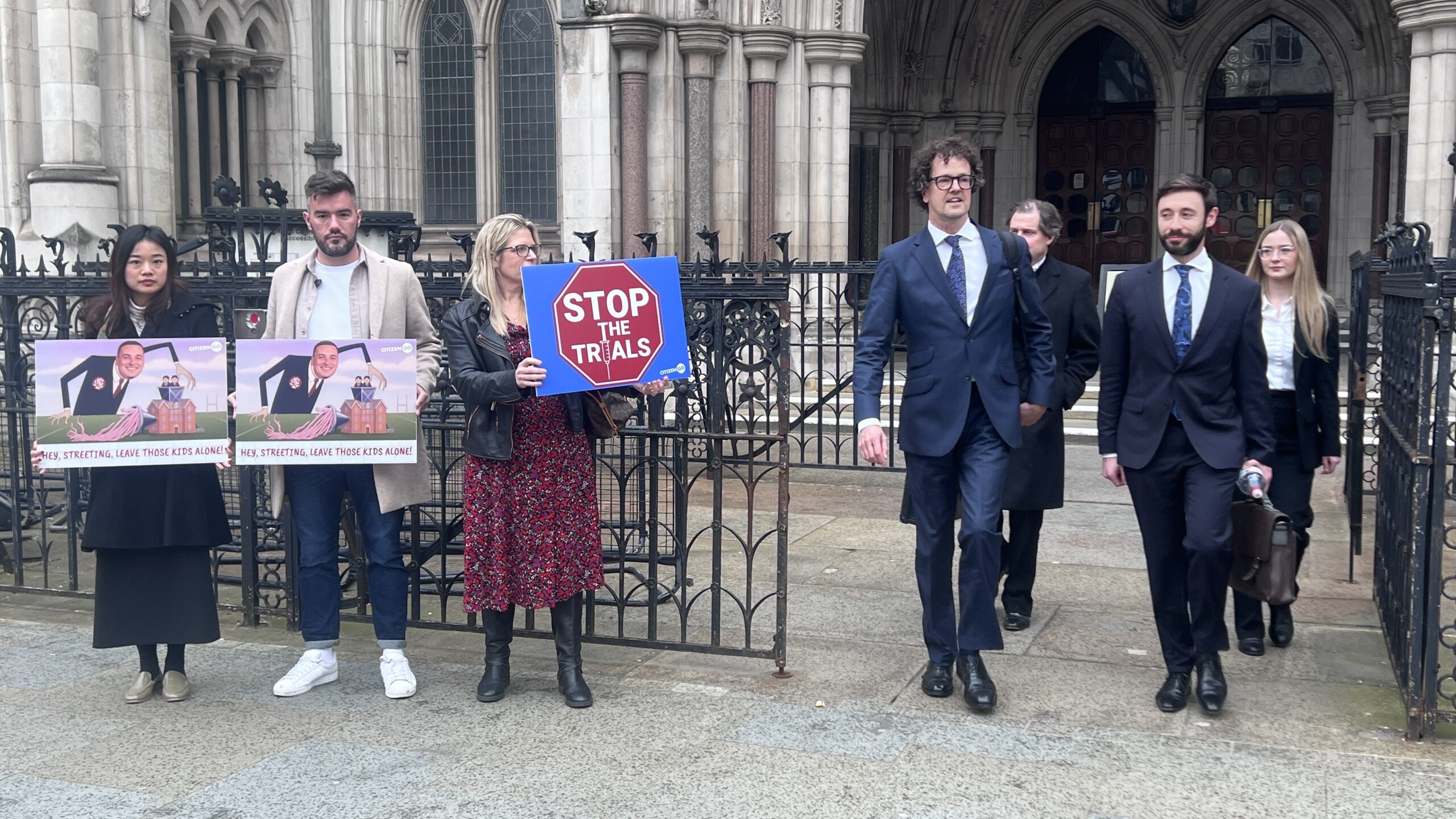
The government’s attempt to stay James Esses, Keira Bell and the Bayswater Group’s judicial review (JR) of the Pathways Puberty Blocker trial has succeeded. There will now be an eight week pause in proceedings to give the Medicines and Healthcare products Regulatory Agency (MHRA) and King’s College London (KCL) a chance to discuss the issues raised by Professor Jacob George before he was recused from involvement in the trial due to his social media posts.
The trial – which plans to give up to 300 pre-pubsescent children drugs to delay the onset of puberty and ask them how they think they’re getting on – was due to start around now. The JR aimed to stop the trial, citing all sorts of problems with the methodology behind it and the harm it might cause the participants. The trial was paused by the government when the MHRA’s Professor George wrote to KCL in February telling them that as there were “potentially significant and, as yet, unquantified risk of long-term biological harms” to taking these drugs and “there should be a graded/stepwise approach starting with those aged 14 as the lower limit of eligibility.”
There were also issues about preserving the fertility of pre-pubescent children. And more.
Esses, Bell and the Bayswater Group (the claimants) did not want a pause. They felt the concerns raised by the MHRA aided their case – which is that the trial should not go ahead, based on the idea that putting powerful experimental drugs into children was likely to cause harm.
At the end of a two hour hearing the judge sided with the government, with two important caveats. First – there would be no recruitment of young people to the PB trial before the end of July. Second – the claimants would get what they need in terms of disclosure.
JR proceedings will now be stayed for eight weeks. In that eight weeks, the MHRA and KCL will decide what (if any) changes need to be made to the PB trial in the light of Professor George’s letter. If the MHRA and KCL cannot agree on what changes need to be made, the trial will collapse, and the JR becomes irrelevant. If the MHRA and KCL make agreed changes, those changes will be scrutinised by the JR at the High Court.
The timetable going forward (as proposed by Andrew Sharland, representing KCL) is as follows:
27 April – MHRA and KCL complete their discussions and issue the new PB trial protocol
27 April – JR re-starts – amended claim form prepared, along with statement of facts and further evidence
15 May – four hour hearing to to determine Claimants’ application to rely on expert evidence
6 July – JR hearing. This will be two days if expert evidence is ruled inadmissible or 3 to 4 days if expert evidence is allowed.
31 July (latest) – JR judgment. PB trial either begins recruiting, or stops.
The timetable was largely accepted by all parties, on the condition the defendants got the disclosure they wanted in good time. The government made it clear that whilst they would not start recruiting any children into the trial before the end of July, they reserved the right to start on 1 August. So – if the JR ruling is delayed, or the JR failed but goes to appeal, the government still reserves the right to start recruiting children to the trial.
One matter of note which came out of the hearing related to the kids in the centre of this. The claimants very much don’t want the trial to go ahead on the basis that they think it will cause harm, and the judge recognised that. King’s College London (and the government) are very keen to get the matter resolved as soon as possible, so the trial can (if it is allowed) go ahead.
Andrew Sharland, KCL’s barrister, said the cohort of potential triallists is “fragile” and “some are self-medicating with puberty suppressants… there’s a high level of self-harm – attempted suicide.”
This was a striking assertion and one I have asked Mr Sharland to clarify. His statement suggests KCL is already in touch with a potential cohort of children (and parents?) desperate to start the trial, and that one of the reasons for urgency is that some of them are harming themselves and self-medicating with puberty blockers.
Is the desperation of some people to potentially self harm a reason for starting a trial? I don’t know. As someone close to the story told me, any child who has already taken puberty blockers is not allowed to take part in the trial. The desperation is therefore important and urgent, but not necessarily relevant. If I get a response from Mr Sharland I will post it here. But it was a significant statement to make in open court and needs to be buttressed with evidence, or, I think, withdrawn.
Thanks to everyone who followed my live tweets yesterday and anyone reading this post. Please donate if you can.
My work on this blog is funded by your donation. If you would like to make a one-off contribution and receive the Gender Blog newsletter and blog posts in your email inbox you can sign up here. Your email address will be stored securely and confidentially, never given to a third party and will only be used to inform you about things I think are interesting. If you have a story, please use the contact form. All messages go directly and securely to my email inbox and will be dealt with in the utmost confidence.
Leave a Reply