In March, the Crown Prosecution Service made fools of themselves, reporting that a “woman” had been found guilty of murdering “her” partner. Reader, the woman was a man. The CPS’ defence was that Aurin Makepeace was afforded female pronouns in court, and this justified the CPS lying to the public.
It is the logic of the genderwang, and should be resisted at all costs. A court (of all places) shouldn’t be allowing people to tell fairy stories about sex. There is also no duty, implied or otherwise, for arms of the state to respect a murderer’s fantasy. Yet here we are.
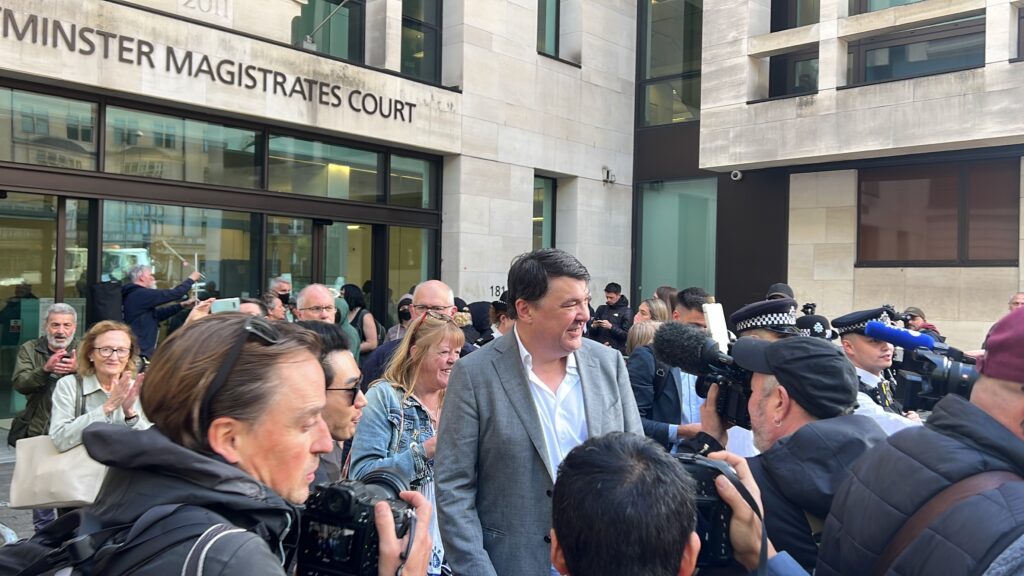
There is a way through this, but it involves thinking. Thankfully two barristers did just that just ahead of Graham Linehan’s trial at Westminster Magistrates Court for harassment and criminal damage in September last year.
The statement, drafted by Sarah Vine KC and Julia Faure Walker (and pasted below), allows for those who believe the earth is flat to call it flat, and those who believe the earth is round to call it round at the same time, in court. The judge approved the statement and read it out in court ahead of each day of the trial.
Her judgment subsequently avoided or stuck to neutral pronouns. It also didn’t offer an opinion on the shape of the earth. That was not her job. Despite getting a guilty ruling on the criminal damage charge, the CPS did not issue a press release, which is a shame, as it would have been interesting to see what state it might have got itself into.
I’ve been meaning to post the Vine/Faure Walker position statement up for some time. In the light of the CPS/Makepeace debacle, there might be an important public service element to doing so. It shows how easy it is to avoid a) compelled speech, b) pandering to the manipulative fantasies of deranged criminals and c) looking a bit dim.
More of this sort of thing, please.
IN THE WESTMINSTER MAGISTRATES’ COURT
R
-v-
GRAHAM LINEHAN
_______________________________________
JOINT POSITION OF THE PARTIES
ON THE USE OF LANGUAGE
_______________________________________
1. This trial is listed for two days on the 4th and 5th September 2025. This position statement has been provided for the assistance of the Court with matters of trial management.
2. The allegations before the Court are set against the context of the ongoing political debate about the conflict between the rights of women and the rights of those who assert transgender identities. While the decision of the Supreme Court in For Women Scotland v The Scottish Ministers [2025] UKSC 16 has settled the position for the purposes of the Equality Act 2010 (at least), the public debate continues. Counsel for both Prosecution and Defence expect the attendance of supporters for both Complainant and Defendant at trial.
3. The Prosecution’s position is that Prosecution Counsel, Miss Faure Walker, should address the Complainant in accordance with the policy set out in the CPS Trans Equality Statement. Miss Faure Walker will address the Complainant according to the Complainant’s “affirmed gender and name, using that gender and related pronouns”.
4. The Defendant’s position is that the Complainant is male, and that the Complainant’s identification as female does not alter this fact. The Defendant’s representatives will refer to the Complainant as “the Complainant” or “Ms Brooks”, and with sex-based pronouns. If he gives evidence, the Defendant is likely to refer, inter alia, to “trans ideology”, “gender ideology”, and “transsexuals”. He will refer to the Complainant in the masculine.
5. No party will seek to police the other’s use of language. The Court will be familiar with the May 2025 edition of the Equal Treatment Bench Book, and the helpful guidance at paragraphs 17 – 20 of Chapter 12. The Court may also have regard to Forstater v CGD Europe [2022] ICR 1 at [104] and [118b], albeit dealing with a different context, in which the Employment Appeals Tribunal acknowledged that a person calling a transgender woman a man could amount [to] unlawful harassment in some circumstances, but that possibility did not deprive the person of the right to do so in any situation.
6. Neither party wishes the use of language to disrupt proceedings. The language used is likely to cause some offence to those attending in support of both the Complainant and the Defendant. The Court is invited to make the position clear that members of the public are entitled to attend, but that audible reactions or commentary on the evidence or the language used that interrupts proceedings will not be tolerated, as with any other misbehaviour (see s. 12 Contempt of Court 1981).
Julia Faure Walker For the Prosecution, Sarah Vine KC For the Defendant
ENDS
There. Not so difficult, is it?
You can download the document here:
I don’t know if this or a version thereof will be adopted before Glinner’s appeal, which begins at Southwark Crown Court tomorrow. Let’s wait and see. I will be live tweeting the appeal hearing, which is scheduled for two days across 30 April and 1 May. Please do come and find me on X if you want blow-by-blow stuff, and please do consider the short message below. I am hoping the generosity of those interested in this story will fund my presence at court.
My work on this website is entirely funded by donation. If you would like to make a one-off contribution and receive the Gender Blog newsletter and blog posts in your email inbox you can sign up here. Your email address will be stored securely and confidentially, never given to a third party and will only be used to inform you about things I think are interesting. If you have a story, please use the contact form. All messages go directly and securely to my email inbox and will be dealt with in the utmost confidence.


Leave a Reply