
“This is not a time to be timid… The entire field of gender medicine is built upon a lie.”

I have been a fan of Mia Hughes since I saw her speak in Lisbon a couple of years ago. She had that year published the WPATH files, internal emails and documents which revealed the true horrors going on at the World Professional Association for Transgender Health.
Mia is British, but works out of Canada as a senior fellow at the MacDonald-Laurier Institute and director of Genspect Canada. Her X profile (@_CryMiaRiver), gives you an idea of just how busy she is, writing, hosting and participating in dozens of podcasts throughout which she hones her message: the genderists got it wrong, and we are all now paying a heavy price.
In fact, Mia’s gift is her capacity to pierce the fog of linguistic and conceptual confusion which pervades this subject and communicate with clarity. Her speech at Genspect’s Life Beyond Transition conference in Washington DC was a banger. I have summarised it below.
Mia’s session at the podium was booked for the morning of 12 March, but she got caught up in an Ottawan ice storm and her plane was delayed. This meant that instead of delivering the closing plenary, Admiral Brian Christine became Mia’s support act. It was Mia’s speech which closed the day. Christine graciously stayed to listen to what Mia had to say and I understand they both had a lively discussion after the event over dinner.
During her talk Mia argued that in the same way detransitioners have to psychologically deprogram themselves in order to get out of the trans mindset, we all, as a culture, need to do the same. “Entire nations”, she said “have abandoned reason… in the name of a false belief”.
To begin at the beginning
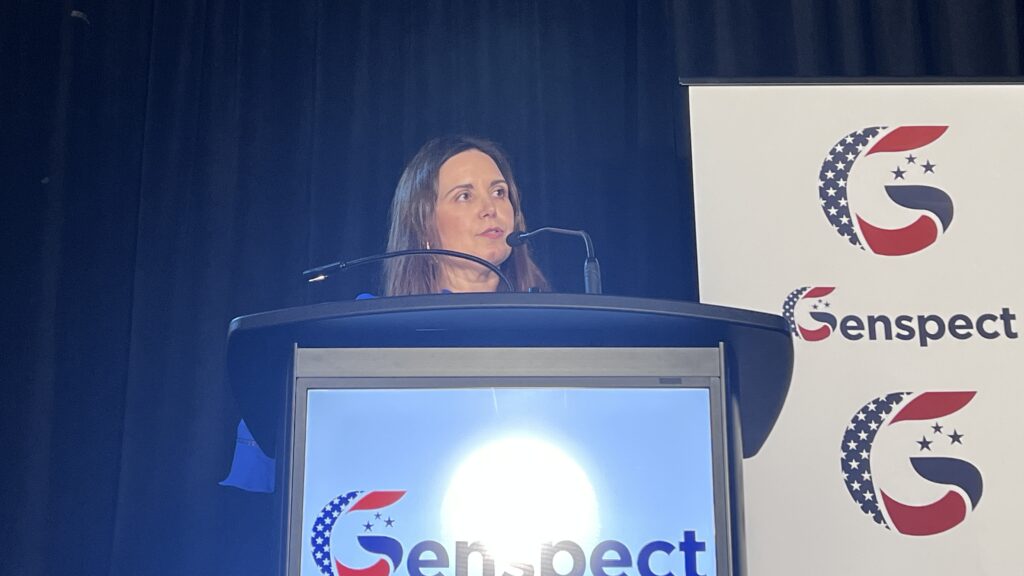
Mia started with a plausible trans madness origins story. “Until the 2010s, Western society… was going about its business as usual. Everyone knew what a woman was. We all understood that adolescence was a time of identity development and great change. And it was a widely accepted fact that wanting healthy body parts amputated was a sign that a person needed serious psychological support. Then suddenly, a new civil rights movement exploded onto the scene, and pandemonium broke out.”
Mia says this movement “was built upon the idea that being transgender is a healthy variation of human existence [which] somehow – paradoxically – requires drastic hormonal and surgical interventions. There is obviously no truth to this claim. It’s the product of decades of political advocacy, in which activists created a whole new reality – one where a complex psychiatric condition is reframed as an innate identity, and guardrails around drastic, life-altering, medical interventions are portrayed as discrimination.”
Y’know, when you stop to think, the whole thing is illogical, but as Mia says “when the idea first appeared, very few people stopped to think… Gay rights were drawing to a close, and it was clear which side held the moral high ground. People were primed to fear being seen as bigots. So when the next rainbow-hued rights movement appeared, one that on the surface looked remarkably similar to its predecessor, people quickly jostled for their place on the right side of history.”
As Mia says “It didn’t matter that the belief was incoherent” – it just landed on fertile enough ground and spread like knotweed. Soon the whole thing “took on a life of its own, leaping from mind to mind, becoming all-consuming in those most susceptible.”
The Over-Valued Belief
This concept of trans as innate – that a child really can be born in the wrong body – is what Mia calls an “over-valued” idea. I’ve come across the concept of over-valued ideas in individuals before, but Mia’s framing presents trans as a cultural shibboleth. She says when convictions around ideas grow stronger “the more a culture reinforces them”. This will subsequently “come to dominate minds if no countervailing perspectives are present”.
So whilst the concept of the self being trans is alighted on by specific individuals, it is not a spontaneous notion. “It was absorbed from the surrounding culture. From institutions, from media, from schools, from doctors, from activists, and from the internet.”
Speaking directly to the detransitioners in the audience, Mia said that whilst many of them knew that physical detransition was difficult, and for some, impossible, both psychological ideological detransition is achievable. This involves a process of “letting go of the belief that you must spend the rest of your life fighting reality… Letting go of the belief that medically altering the body is the path for authenticity and happiness. For some, that means letting go of the ideology that told you you were born in the wrong body. For others, it means recognising that living as the opposite sex, will never deliver the happiness that was promised.”
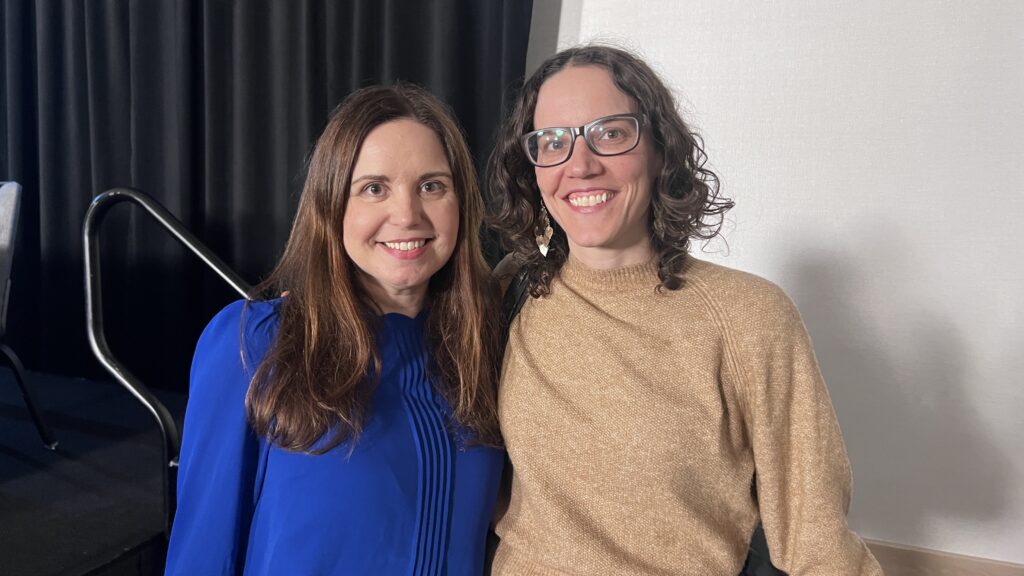
Mia then said something hopeful, which I have also heard from detransitioners themselves. When the belief dissipates “something remarkable happens. There is immense relief. The exhausting effort of constantly trying to bend reality disappears. In its place, there is acceptance. A deep understanding of the self, and reconciliation with the body that you were born with. The only one you’ll ever have.”
Mia acknowledges letting go is hard. You have to admit you made a mistake, first of all to yourself, which involves “confronting sunk costs” and then you have to raise the matter with your peer group, which can mean “losing friendships, and being expelled from once-welcoming communities.” And, crucially, “it means doing all that while the belief is still being celebrated all around you… in a culture that condemns anyone who dares question it.”
This is where everyone needs to pull their weight. “True support”, said Mia “begins with society wide, ideological detransition… We must stop pretending that a new type of human being has been discovered, that a serious psychiatric disorder is a healthy, innate trait. We must stop pretending that amputating healthy body parts is medicine for anyone of any age. And we must stop pretending that becoming a lifelong medical patient is a human right, something to be encouraged and celebrated. But as history shows us, it’s hard for people to let go of false beliefs.”
Mia turned her attention to an issue which is live both in the UK and the US. “Nations are banning these treatments for minors” she said, “yet they are made available on demand for adults, as if something magical happens at the stroke of midnight when a young person turns 18. There are constant calls for better quantity evidence, yet producing that evidence requires subjecting even more healthy people to those same interventions that have already been shown to cause so much harm. All this confusion stems from one simple problem. Our culture refuses to let go of the belief itself.”
Mia once more directly addressed the detransitioners in the audience: “All of you in this room who were harmed by this medical scandal, you’re on your own individual journeys of recovery, but by speaking publicly and telling new stories, you’re also doing something much larger. You are helping spread the idea that recovery is possible. You are the role models your younger selves so desperately needed, but that society failed to provide.”
By speaking out, destransitioners are embodying the idea that there is “life after transition – life after letting go of the belief. Every detransitioner who speaks publicly gives this idea strength. Your stories become templates that guide others towards letting go of the belief. In the same way that thousands of young people, including many in this room, once encountered someone like them, [usually] online announcing, ‘I’m trans’, and soon adopted the label themselves, now those same people are encountering detransitioners. People who have the courage to say, I once believed I was trans, and now I realise it was all a lie.”
Mia has a simple call to action for all of us. “This is not a time to be timid. This is the time to pull out the megaphones. The time to say plainly that the entire field of gender medicine is built upon a lie. That people who fixate on these medical interventions, as the road to happiness, do not need scalpels and hormones. They need compassionate psychotherapeutic care that guides them towards a less destructive path.”
It was a powerful speech, and as soon as it is published in full, I will link to it here.
The Life Beyond Transition conference took place in Washington DC on 12 March 2026 and was organised by Genspect. You can read all my live tweets from the event here. You can also read my write-up of the speech made by Admiral Brian Christine (US Assistant Secretary for Health), and Andrew Ferguson (Chairman, US Federal Trade Commission), as well as the really interesting talk on what she’s learnt about detransitioning children and young adults by Erin Friday, President of Our Duty USA.
My work on this website is funded by donation. If you would like to make a one-off contribution and receive the Gender Blog newsletter and blog posts in your email inbox you can sign up here. Your email address will be stored securely and confidentially, never given to a third party and will only be used to inform you about things I think are interesting. If you have a story, please use the contact form. All messages go directly and securely to my email inbox and will be dealt with in the utmost confidence.


Leave a Reply to Christopher Padley Cancel reply