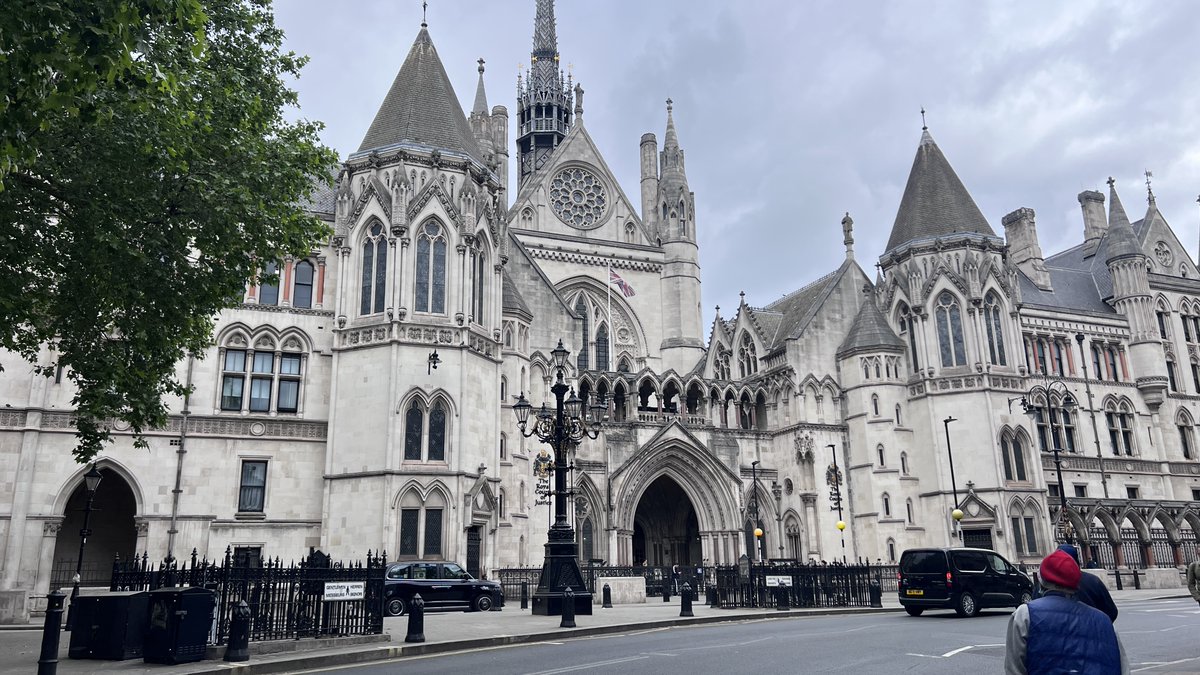
Live tweets from the Royal Courts of Justice, London where we are hearing R v The WellBN partnership.
Part 1:
Good morning and welcome to Court 39 of the Royal Courts of Justice in London where we are expecting to hear R v The WellBN partnership.
This is about what has been happening at the WellBN gender clinic in Brighton. The story was first exposed by @Hannah Barnes in the New Statesman here https://www.newstatesman.com/politics/health/2025/08/health-bosses-failed-to-act-on-nhs-clinic-prescribing-gender-drugs-to-kids-for-five-years…

newstatesman.com/politics/healt…
Health bosses failed to act on NHS clinic prescribing gender drugs to kids for five years
And features in the paperback edition of her superb book Time to Think, which exposed the goings on at the Tavistock and is, to my mind one of best works of investigative journalism into almost any subject, let alone the gender wars.
(I’m not just saying this because she’s sitting next to me)
Proceedings are due to start at 10.30am. PA Media are here and quite a few hacks in total. Stephanie and Shelley from @TransgenderTrend are also observing.
No one really knows what to expect today. There is an anonymity order on the claimant and first interested party concerned. They are to be known as ATN and ATT respectively.
I will live-tweet what i can. Please note NOTHING I tweet is a direct quote unless it is “direct quotes” – it is a summary or characterisation of what is being said or happening in court.
Vikram Sachdeva KC (VS) is acting for the claimant
Nicola Newbegin KC (NN) is acting for WellBN
VS is reading from Cass about clinical intervention and decision-making for gender dysphoria and is now referring 2024 NHS policy on prescribing hormones to 16 – 18yos
which you can find here: https://www.england.nhs.uk/wp-content/uploads/2024/03/clinical-commissioning-policy-prescribing-of-gender-affirming-hormones.pdf…
VS although it’s aimed at ICBs who contract to GPs, it does set the “outer limits of what GPs are permitted to provide”
VS now going into the NHS Act 2004 and other regulations how it relates to the commissioning and provision of “essential services”.
VS is making the distinction between specialised and primary care services under the various regs
[whilst this bit of referencing is going on for the benefit of the judge – I would be grateful if you would consider bunging me the value of a coffee, pint or train fare as I am doing this purely as a crowdfunded venture: https://genderblog.net/donate/]

[I do feel like I should get a proper job when I see the journalists sitting either side of me – but I am at your whim and service, for better or worse…!]
VS quoting WellBN’s press statement after the 2024 NHS hormone ban which railed against the “targeted discrimination against transgender youth”
It is quoted in this Telegraph piece here: https://www.telegraph.co.uk/gift/95df71bebc25babe…

telegraph.co.uk/gift/95df71beb…
Clinic ‘defying Cass review to prescribe sex change drugs to vulnerable teens’
VS explaining how a JR was filed last year against the WellBN policy of continuing to prescribe hormones to u18s.
VS in 2025 NHS wrote to WellBN telling it that the prescribing policy was neither bridging prescriptions nor liaising with specialised commissioning services.
VS NHS told WellBN to stop providing gender-affirming hormones to children or its GP contract would be terminated. WellBN said it would cease but then wrote to the NHS saying it had the right to provide hormones as an essential service.
VS my lord has read the grounds of review. There are two of them. The first one is that the defendant’s policy of providing hormones is unlawful as it is not an essential service. That’s what the NHS told them and “even” the BMA agree.
VS there is a fundamental disagreement which is ongoing as to whether it is lawful for a GP to provide GAH within the NHS contract.
J – that’s not for this court to decide.
VS – well there is a dispute of law which cannot be said to have no consequences. The claimant is not just in relation to their own child… until this JR was filed the NHS was not doing much about this. There is a public…
… interest in the wider situation.
VS the second ground is the policy is unlawful under common law in that a GP could not give treatment after Cass and the subsequent guidance – the defendant has to have regard to it or follow it.
J – I’m conscious of the time. I want to hear subs on prelim application decide on it and then get on.
VS I have one more sentence – there is no sign the WellBN policy has taken any account of Cass etc
… there is no mention of Cass or the commissioning guidance to which they have to have regard. They’re trying to say well the guidance was directed at ICBs, but the effect is on treatment providers. The idea they don’t have to take notice is “alarming”.
VS onto app for disclosure. You have our subs. What we know is that NHS England has commissioned an independent safety review of concerns over use of exogenous hormones…
VS the ToR say that NHS is aware that WellBN has been offering hormones to several u18s. We also know there are some 70 patients in this category who have been included in this investigation
VS we also know that 3 members of WellBN have been reported to their professional bodies. They have the report, and they won’t give it to us.
J – how will it help us make a decision in this case
VS the contents of the report contains discussion of this case. and if the report says there is a serious deviation from all professional standards, that is highly relevant to ground 2 of our argument.
VS and given what might have been going on “there is likely to be regulatory liability, civil liability or possibly even criminal liability”
VS the extent of deviation from professional standards is directly relevant to Ground 2 – by adopting the informed consent model which Cass says in breach of guidance about how to prescribe
VS on the other hand if there are particular findings as to the effect in this case then that could be directly relevant to the factual findings made in ground 2 and indeed the policy. If it is potentially relevant to the arguability of this claim, then we are entitled
to at least see what the report has to say about this. If my lord were to refuse to let us see it and then the report comes out and it is relevant it would be unfair. If this is an unarguable claim what’s the harm in releasing the report?
Even the defendant has not said the report is irrelevant – it says there is sufficient information available to argue the point
Given this is looking at professional standards or extent of deviation from prof standards we say it should be disclosed.
NN the NHS objects to the disclosure of this report on the ground its not relevant. In terms of confidentiality we are under strict obligations to people named in the report. It is a 3rd party report. it will be shared with regulators who will take appropriate action…
… as they see fit. It is not relevant to this case.
NN our position is that you have the policy they rely on. Even if it becomes relevant later which we don’t accept it will it is not need now to decide the matter in hand.
VS the q of whether the def has complied with its duty of candour is not directly linked to whether there is sufficient to make a determination. The obligation turns on what is in the report. If it makes clear findings about the def’s conduct it is directly…
… relevant to the JR. And we can infer there is critical comment. There have been three people referred to the regulator. There is enough to infer this report is relevant and should be disclosed.
J this court is concerned with the permission stage of a jr into the def which is a GP practice. The claim is brought by the father of a minor treated at that practice – before the court reaches the subs as to permission
… it is required to deal with an app to adjourn the hearing and order the disclosure of a report about the clinic’s activity. NHS has commissioned that report into the provision of hormones to young people at that practice.
… a report has been produced and is now finalised. C says the report is relevant and should be disclosed. The purpose of the investigation is clear from the ToR that is has 9 aims – to ID patient harm and potential harm, to ensure patients are support, to ID any breach of
gov restrictions on H provision, whether there needs to be any referrals to the police, whether there needs to be a review of treatment plans, any required prof standards investigation in respect of individuals
C’s claim is about prescribing policy of giving H to young people. Says it was done without regard to relevant policies and framework. The ToR says the report largely deals with a different issue. It deals with the consequences of what was happening. I do not accept the argument
… it is directly relevant. The ToR does regard the supply of H to children and even seems to imply it was inappropriate. However whilst the ToR includes any breach of regs that is something another court can consider. The fact the report might…
disclose probs with the policy doesn’t take us any further. This about whether the C has an arguable case.
The fact the case is at the permission stage is fundamental to the outcome of the prelim application. It needs to id the policy impugned and the legal framework in which it was crafted and ID if it was unlawful. D’s policy was published on its website…
… and the framework in which it was crafted is before the court. Disclosure is an unusual course of action to pursue in a JR, particularly at the permission stage. I am not satisfied the court should order disclosure of the report.
J we proceed to permission application
VS turning to subs on the arguability of the case…
VS D [defendant] says case is no longer arguable. We say that the decisions in this case was made by a public authority, C has standing, the claim is not academic even tho the policy has been changed
J where is that argument
VS ground 1 my lord. they treated 70 patients and claimed money for that and we say that was unlawful
J but where is the evidence of the ongoing dispute
VS the 15 April 2025 letter WellBN sent to the NHS saying it was acting lawfullly –
… that position has not changed. if they have changed we have no evidence of it.
J but where is the ongoing dispute
VS the D says they are entitled to act the way that they did and there are 70 cases just from this one clinic – although the policy has been withdrawn…
… there remains an issue as to whether it could or should have happened “so in the interest of patient safety there is a public interest in the court ruling as to whether the NHS can provide hormones to children under the GMS contract”
[J is v unsure about this]
VS GPs are providing services as a public function and if they might be doing so unlawfully that is something that can be brought before this court.
[J seeks to be persuaded this isn’t a regulatory or contract matter]
J why not go to the reg it’s seeking to turn the admin court into a reg. if someone is dissatisfied with the conduct of a GP, they go to the regulator
VS the regulator has been approached. Cass is authoritative and has “even” been accepted by the BMA. It’s quite hard to see what
the GMC has done about this. They don’t seem concerned. The problem is there is ambuiguity as to the ambit of the GMS contract and the reg can’t give a ruling on it.
Only a court can.
J neither can I. All I can rule on is the JR.
[VS is arguing public interest and that of C for his child]
VS notes “trenchant” position from WellBN of last year and turns up letter from NHS to WellBN saying this is not right – we are not paying for this – it’s outside the ambit of the contract cos…
there’s a difference between primary care and specialised commissioning – gender care is within specialised commissioning AND it’s not within essential services. and the response from WellBN is still
that they had a right do this. If they didn’t there’s a question of what happened to the money. D wrote back to NHS to say we will stop but we think you’re wrong, they don’t attempt to deal with the statutory argument.
They duck it completely and simply seek to rely on the express words of the contract, but if there’s a statutory background to it we have to interpret the meaning of the contract. We can construe the contract in isolation from its highly relevant background.
D’s position is that people with Gender Incongruence are ill and are suffering from something from which they can usually expect to recover through treatment. The BMA guidance does not help.
dealing with the academic point – there’s a discretion to hear in a JR even if there’s something which doesn’t directly affect the parties “unless there is a good reason in the public interest for doing so”
J on your argument it does involve a huge number of disputes of fact – so doesn’t it fall outside Salem [the case which raised the exception for potentially academic cases]
VS there are no factual disputes in this case which are central to the determination of the JR. We have two grounds – discrete point of statutory construction and are GAH to children an essential service?
J how am I determining whether it is an illness from which a child can recover VS it’s a matter of construction – there’s a legal definition of essential services and its for the court to decide
what that means in the contract – it’s not about expert evidence. The facts are it’s essential services and its GAH for 16 – 18yo – is that an essential service and NHS England says it’s not.
VS you only look at essential services once you pass it through the hoop of being primary medical services and it can’t be given there is specialist commissioning for it.
VS there is every possibility that another GP which takes a similarly robust and pro providing hormones may seek to interpret the care in this way and it is unacceptable that this uncertainty prevails.
VS a High court judge has expressly stated that… GPs appear to have relatively free reign as to what they prescribe under law [in ABCD – another case] – WellBN have said they are not bound by the guidance issued by the NHS. There is a very active dispute
J yes
VS current BMA guidance says that GPs may have competence to prescribe hormones even before seeing a specialist care provider. Many GPs are members of the BMA and therefore may take note of this guidance.
This could be it: https://www.bma.org.uk/advice-and-support/gp-practices/gp-service-provision/managing-patients-with-gender-dysphoria…

Gender incongruence in primary care
So this is directly contrary to the Royal College of GP guidance and the Cass Review. It says here prescribing is not part of the GMS contract, presumably so private prescribing can be provided.
J yes
VS this is not an arid dispute its ongoing and this about whether or not GPs can prescribe hormones to children and that is what renders this “far from academic”
VS it is also a matter of statutory interpretation.
J yes you’ve made that point.
VS the threshold for permission is indisputably is whether the app is arguable and has a realistic prospect of success. The threshold is for a JR is low.
VS it is only if the legal position is entirely clear and the claim could not succeed. We are not entirely clear and and we don’t know the claim cannot succeed by logical inference.
VS so amenability to JR… the bottom line is there is a dispute over whether WellBN is dispensing a public function. it says it is a private law partnership. That’s plainly wrong if it acts outside the law of its contract. If it loses its contract that will have a public effect
VS this is NHS primary healthcare and if a GP practice loses its licence, immediately hundreds of people will lose access to primary healthcare. The powers the GP are contractual, but are prescribed by statute.
[goes to case law (Beer) which states that there is a public law function to a body’s actions rather than its contractual provision for doing so]
Part 2:
This is part 2 of the permission hearing about a judicial review asking the High Court to rule a Brighton GP practice of prescribing cross-sex hormones to children unlawful.
[nothing is a direct quote unless in “direct quotes”] VS the idea a GP practice is not providing a public function is “absolutely for the birds”
J yes
VS lets move on to alternative remedy. if there is an alt rem – JR is a rem of last resort. it was floated by my lord that the fundamental in this case was the treatment. this claim is much wider than the provision of treatment to my client’s child…
… this app has had some positive effect in that NHS England got WellBN’s prescribing policy suspended. But whether it’s lawful or not is still in issue. There is no other way that coming to the court. To diminish this challenge as to what happened in this case is
not right and also something this court could not decide anyway. That’s for the family court. There is no suitable alt rem
J yes
VS as for standing, the bar for standing at the permission stage is to preclude “busybodies”. my client
is not that. He is directly affected and wants clarifcation in the law – he doesn’t want other families to go through what he has been through with a GP surgery acting totally contrary to Cass, the NHS Guidance and the
guidance from the Royal College of GPs. After looking at the efficacy of GAH, Cass found the evidence base was very weak. There’s no good evidence they work
[“cranks, meddlesome busybodies and troublemakers” is the full quote from the authority on standing]
VS where a policy is unlawful it can be set aside – “this [WellBN prescribing] policy does encourage unlawful conduct”
VS WellBN saw banning of H as “discrimination” – they pushed back against what the gov is seeking to do and that is encouraging unlawful conduct, which brings it within Gillick [another authority]
VS on the timing front it is said this claim is out of time. the policy was an ongoing policy when the JR was issued in Feb last year and continued till May last year when the policy was withdrawn.
VS the father in this case tried to interest the regulators, the GMC, the local authority – nothing happened UNTIL the JR was issued.
VS that’s it
J thank you
[NN on her feet]
NN we submit the threshold for permission has not been reached and that there has been no public law error [goes to stat underpinning of the GP contract]
NN what is absolutely clear is that there are contractual arrangements and there are no public duties. Whilst the stat duty is under the delegation agreement to the ICBs there is no onward delegation.
[goes into contract as to how delegation takes place]
NN NHS England is the stat body. It has the duties and the power to enter into contracts.
[goes to def of essential services – re conditions from which recovery is generally expected and the definition of “disease”]
NN there is a huge factual dispute about what falls into what relevant legislation.
NN we have a breach of contract dispute which can be dealt with a commercial adjudicator. There are alt rems in this case should the ICB wish to pursue them. Factually we know that…
my clients thought they were providing services within the general medical contract. and then they stopped. They complied with the remediation notice as they should. They’re not going to go fighting for their licence to do this.
They have complied and cooperated and no one is suggesting they haven’t. There is an ongoing process to decide what is best for these 70 patients and that is primary a clinical decision in practice.
NN going to authorities on amenability [case law about Southern Cross and withdrawal of care service]
[lots of confusing stuff about performing a statutory function and whether a GP practice is or isn’t]
J this talks about private orgs. NHS and GPs sit in a different place don’t they?
NN no GP surgeries are in effect small businesses – they operate at a profit. They can be entirely private if they want. They can enter into a GMS contract, or they can be a mix.
J “so they’re public in the mind of the public but not in law”
NN “I suspect most members of the public haven’t had the pleasure of the GMS contract”
[more case law – “the fact a service is for public benefit, does not mean it is providing a public function”]
NN restaurants are heavily regulated, but they’re not providing a public function. and the fact that a public authority COULD have provided a function doesn’t make it public
NN public functions have to be fundamentally governmental in nature – there is nothing governmental about a GP practice.
NN moving on to academic “it’s simply now inarguable” that this case it now academic
NN the service is no longer being provided.
NN we’ve got no evidence a large number of cases exist or are anticipated and the fact that we have an investigation into 70 patients, none of whom are here is rather telling
NN it’s clear that this is now an historic policy and there are many reasons not to extend it. This is a huge public debate – it should be in parliament and public – it’s not for a court to determine.
NN the public interest must reflect the interests of ATT herself and the impact being made on her in these proceedings.
[must be interesting to be in court and hear a lawyer describe your male child as “her”] NN there are two public bodies involved here, but they’re not the defendant
NN on standing, the father does not have standing in this case – “the child has at all times been over 16”, has the capacity to consent. “She is noticeably not bringing
this claim” and “she turns 18 in 9 days time”. “there is no way the outcome of this JR can affect her or her family” and no evidence there are other young people who would support the application
NN “it’s so obvious he doesn’t have standing… however genuine and however heartfelt his views and I’m not here to second guess them, he does not have standing”
[sorry that was NN’s comment about the father bringing this claim]
NN father talks about going into child’s bedroom and confiscating a prescription – so when he said to the GMC he didn’t know the child was still being prescribed, he did know
NN father knew on 30 Oct 2024 that child was taking hormones. So it’s out of time.
NN there was nothing to stop the claim being brought in time. There’s no basis for extending time on this case – neither in public interest or child’s interest.
NN it appears C had time to notify the press before filling a claim and we do wonder how that was possible – presuming it was the claimant.
NN moving onto the total lack of merit in this claim. There is nothing to JR – the claim is that D’s services were outwith the contract. That’s about the proper interp of a contract. Not for a JR. There’s no public law illegality or error ID’d.
Alexis Hearnden (AH) is on her feet for the child.
AH ATT is willing to speak but is not here and I have not given her skeleton to the press because I don’t know her view on that.
AH ATT has said that her personal story has been highly politicised and its always diff when parents choose to engage lawyers to challenge their choices.
… If matters were to proceed after she turns 18 she can decide whether or not take part. The fact she is planning to sit 3 a-levels and that exam period has started might be one reason why she isn’t here.
[AH finshes]
[VS back on his feet]
VS this is a case about primary medical services – I can see NN has taken every point they can think of, but this one…
[this is the argument as to whether a GP is providing a public function]
[VS says case law says the nature of a GMS contract is of the nature of a public function]
J its an exercise in drawing an inference of an obiter statement
VS no it was the reasoning in a judgment about the provision of GMS services. “It wasn’t obiter. This is binding”
J it’s not a statement of the law – you’ve gone as far as you can go
VS my submission is that this binds you to find the GMS contract provides a public function
VS moving on
J yes
VS standing. my learned friend ducks the bar which is being a “busybody”. my client wants to find a resolution to this issue. their child is directly affected.
VS you are bound by that test – you can pontificate about whether it is met, but at no point did my learned friend seek to describe my client as a busybody
VS in relation to being out of time – where a policy is ongoing there is every reason not to be out of time. You wouldn’t refuse an extension of arguable time if a policy is ongoing at the issuing of proceedings.
VS the policy was extant when we did issue. I think you’ve heard more than enough from me…
J I propose to reserve judgment in this case. Thank you. I will rise.
[court rises]
That’s the end of the hearing. Thank you very much for sitting through the tweets. I’ll go and find somewhere to write this up. It will appear as a report on http://GenderBlog.net
If you have found this useful and would consider bunging me a fiver for the work I am doing in this area I would be extremely grateful. If you have already today – thank you very very much. It means a lot. https://genderblog.net/donate/