
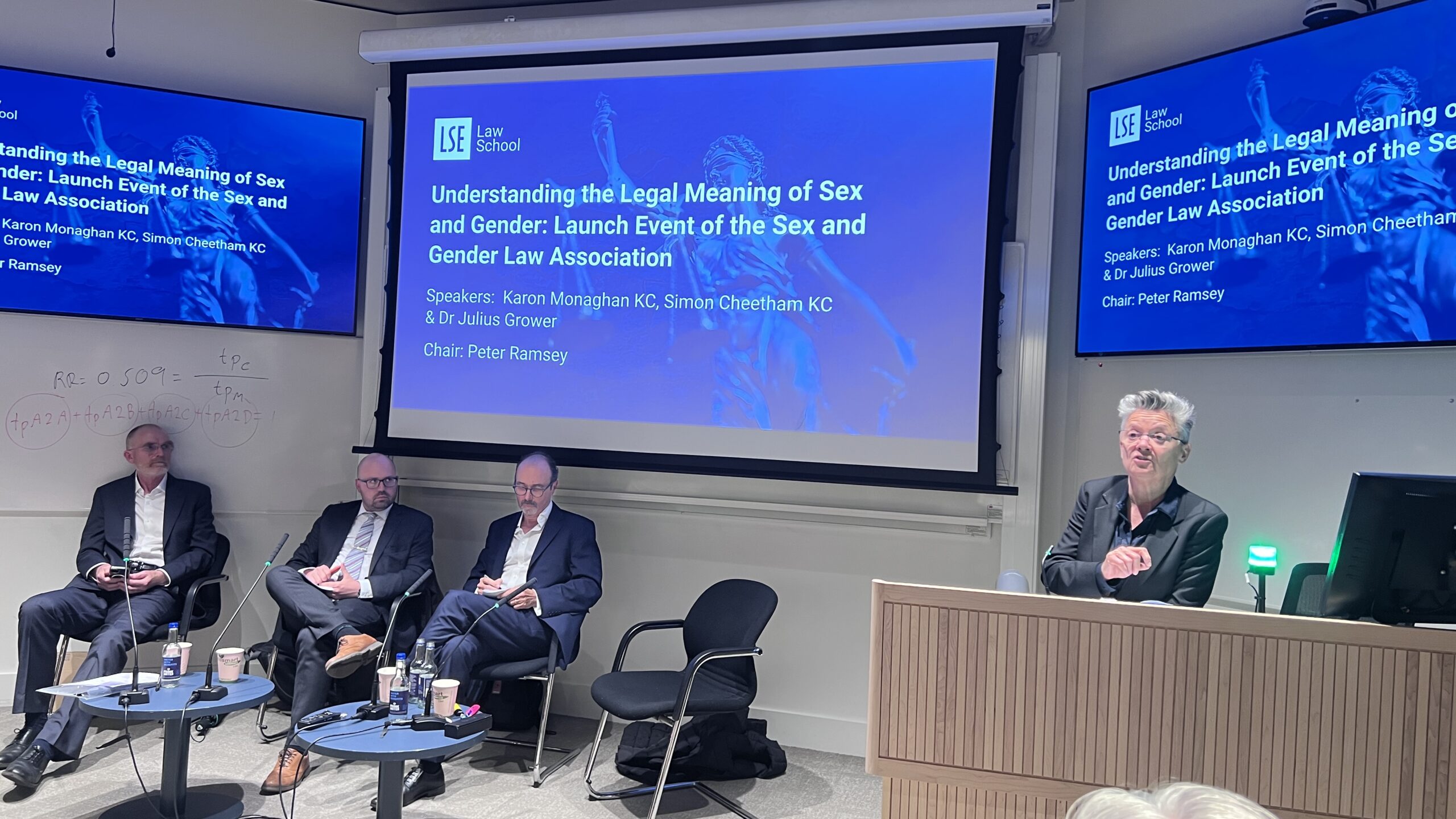
Fair play to Simon Cheetham KC. He opened his talk by thanking the chair Dr Julius Grower for listing the gender cases he’d been involved with, adding “what that flattering biography failed to mention is that in terms of the cases involving these issues, I’ve lost them all.” There was laughter, compounded by his pay off, which was “If you are an employer looking to lose a case in this field, I am the go-to lawyer”.
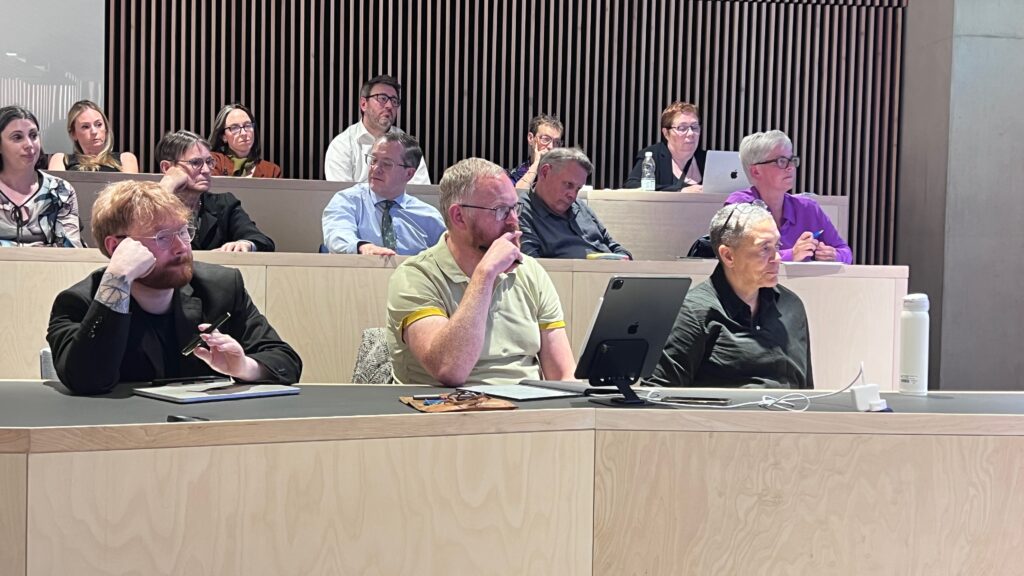
The overall tone of the inaugural Sex and Gender Law Association event on Thursday 4 June 2026 at the London School of Economics’ Marshall Building in central London was good-humoured, respectful and informative. Cheetham said his piece, Karon Monaghan KC said hers and the sell-out crowd of (mainly) lawyers listened attentively, before asking some impressive questions of their own.
In chronological order
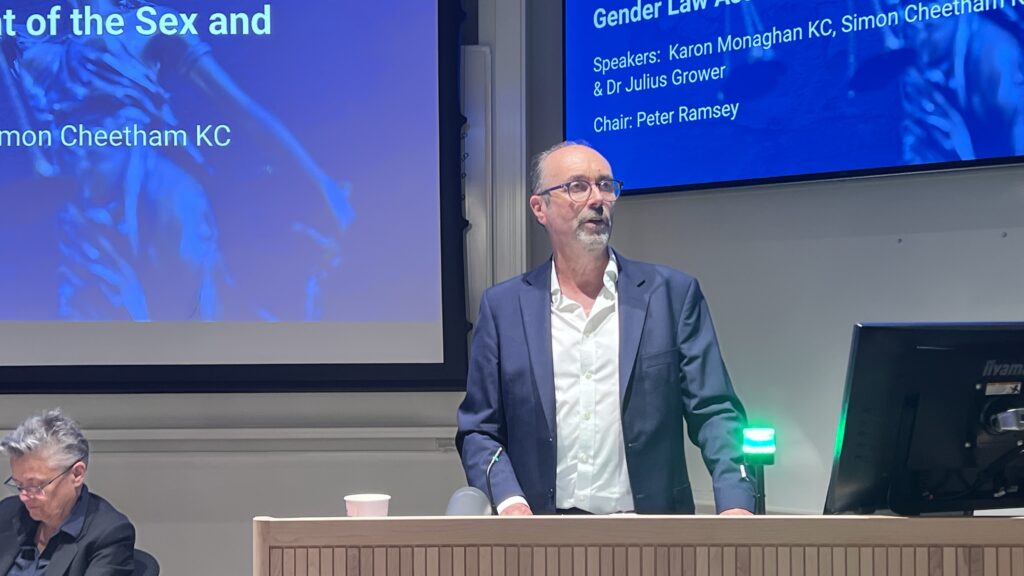
Cheetham started his take with: “You should never begin a talk by saying ‘this is the dull bit of the evening’ but… this is the dull bit of the evening.” He then gave the audience a brief history of transgenderism as it has appeared in law.
Cheetham identified the first legal use of gender as per the concept of reassignment arriving via Sweden, which passed a Gender Recognition Act in 1972. This allowed adults to change their gender in law. How very progressive. Cheetham told us it also required, at the time, compulsory sterilisation. How, er… oh.
In terms of the UK, there was no statutory framework for gender reassignment in the 60s, 70s or 80s. It rose up via family law – April Ashley being the highest-profile case. Ashley was a man who passed as female and had transitioned with surgery. After being outed in the media, Ashley married the somewhat obsessive Arthur Corbett (the 3rd Baron Rowallan) who then tried to divorce Ashley (after 14 days) claiming the marriage had not been consummated. Arthur Corbett won the case (Corbett v Corbett 1971) on the basis that Ashley was legally a man, despite passing and despite the surgery, and the law did not allow same-sex marriage.
Cheetham’s talk took us through P v S and Cornwall County Council (1996), in which a man proposing to undergo surgery to remove his genitals was dismissed in a round of redundancies. The industrial tribunal “in Truro, of all places” concluded the reason for dismissal was the proposal to undergo surgery. The court noted there was no remedy under the Sex Discrimination Act, as the SDA only concerned itself with men and women. This, in turn, led to the SDA being amended in 1999 to protect those “intending to undergo, undergoing or having undergone” sex reassignment “under medical supervision”.
Cheetham moved onto a “completely different” strand of law which led to the Gender Recognition Act (2004). This was a result of Bellinger (2003) in the House of Lords and Goodwin v UK (2002) and I v UK (2002) at the European Court of Human Rights which held that failing to acknowledge the legal status of someone who has changed gender was against their human rights. The GRA, said Cheetham, “enables transgender people to apply to the gender recognition panel, to receive a gender recognition certificate and having obtained that, from the date of issue they are considered in law to be of their acquired gender“.
Cheetham took that up to the Equality Act (2010) which, when considering gender reassignment, “removed the requirement for there to be a process undertaken with medical supervision”. Cheetham then got into the language of the Equality Act and the status under which one might be “proposing” to undergo gender reassignment and how and when that triggered possible discrimination. Cheetham was also quite clear about what was not protected by the Equality Act, and that was “gender identity… a person’s innate sense of their own gender” including “non-binary” people, or those with a “gender fluid” identity.
Cheetham declared he was not going to talk about “toilets and bathrooms” even though it was his “chosen specialist subject if I ever get to Mastermind”. He recognised the issue provides “the battleground in which most of the current debate is fought” but swerved it on the basis that “they’re not actually within the remit of this talk” (entitled Understanding the Legal Meaning of Sex and Gender) because “they’re not actually of part of the legal definition of gender reassignment, they’re simply the unhappy consequence.”
Grooming Goodwin
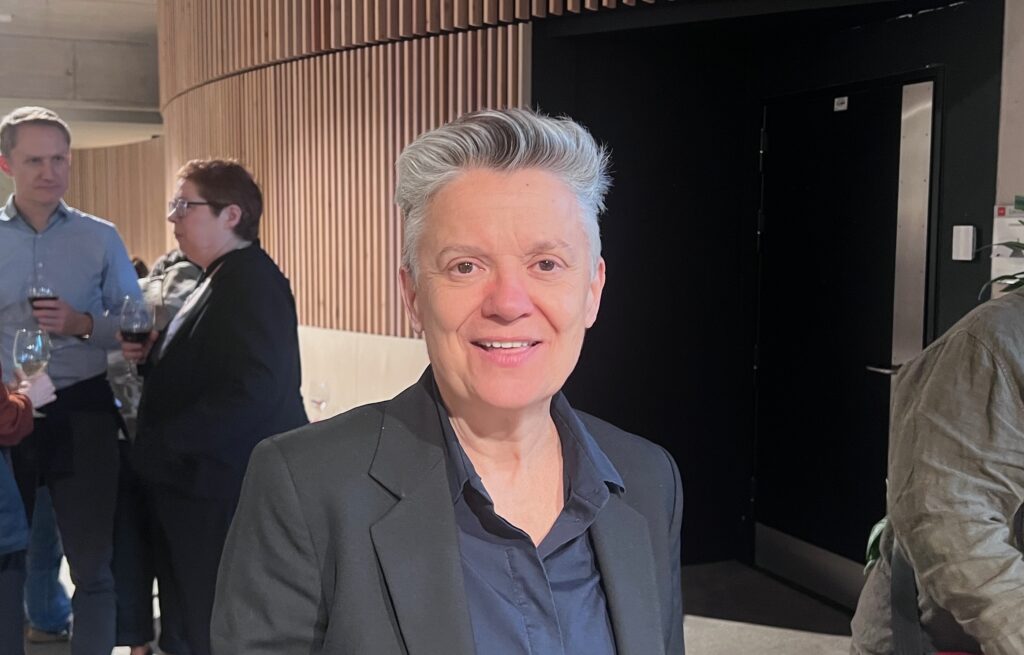
Karon Monaghan signalled she too had no interest in talking about toilets and bathrooms, but was keen to talk about gender as a regressive concept. The female “gender” was about being a carer, a low-paid worker and this, she said “remains material” because the concepts in law which acknowledge gender entrench gender stereotypes as “a regressive feature”.
Monaghan (who, like Cheetham, wore a suit, has short cropped hair and was not wearing make up) noted that gender “tests” involve “dress, appearance… demeanour… what one looks like, how one presents…” and therefore whilst gender in the wild might be, well, wild… gender in law is a “profoundly conservative notion”.
“As to the concept of sex ” said Monaghan, “it has always been biological at common law… However much a body was changed through surgery – sex could never be changed… that was the common law position and it remains so.” Monaghan told us that in 1970 – when the Corbett case was being run – the court noted a distinction between sex and gender, and the judge in that case said gender was about “the social attributes associated with sex”.
Monaghan noted that the Goodwin case, which gave rise to the Gender Recognition Act, made much of “grooming”. Not the grooming that you or I might think of nowadays, but grooming as a differentiator between a man and a conceptual woman (eg applying make up and brushing one’s hair). In Monaghan’s words “if one looks at the history in Goodwin… so not the substantive parts of the judgment but the narrative at the beginning setting out the history… one can see that as part of the treatment afforded to Goodwin was grooming lessons. Apparently, a trans woman has to be groomed at grooming lessons if she is transition into a woman. Again, social attributes… very conservative and descending into real… disadvantageous stereotyping.”
Goodwin did though, lead to the acknowledgment (during a time when marriage between same sex couple was not allowed) that there should be provision for people who had transitioned to marry in their chosen gender “and allow some formal legal recognition of a change in status.” Monaghan moved on to the Gender Recognition Act, which she described as “profoundly conservative in parts”. The GRA states a man wishing to get a Gender Recognition Certificate must “live” as a woman. “I don’t think when they say that,” said Monaghan “they mean that they should receive lower pay, that they should be subject to the male gaze, that they should be subject to serious sexual violence and that they should start looking after the children and old people in the family.” Cue audience laughter.
Monaghan then ran us through the legal route which brought For Women Scotland to the Supreme Court. It was via the Scottish Parliament’s Public Boards Act which were aimed at “securing a 50/50 representation of men and women as non-executive members of public boards”, where women were defined as “being female… and also those who were undergoing or had undergone a process of gender reassignment, where their reassigned sex was to be female”. The Inner House (the Scottish equivalent of the Court of Appeal) found this to be outwith the powers of the Scottish Parliament because “it sought to modify the meaning of sex within the Equality Act” by conflating sex with gender reassignment.
This led to the Scottish government having another crack by changing the definition of woman in the same Act to mean both biologically female women and men with Gender Recognition Certificates. The Inner House called this lawful, as a GRC changed sex “for all purposes”. This concept became known as “certificated sex”. For Women Scotland took this to the Supreme Court which, in Monaghan’s words, “held sex is biological as a matter of common law, sex was biological under the Equal Pay Act and the Sex Discrimination Act” and that “sex under the Equality Act was also biological”. Monaghan called this conclusion “completely…. unexceptional. It was inevitable that they would conclude that sex was biological.” Any other ruling would be “utterly unworkable”.
Yes, but toilets
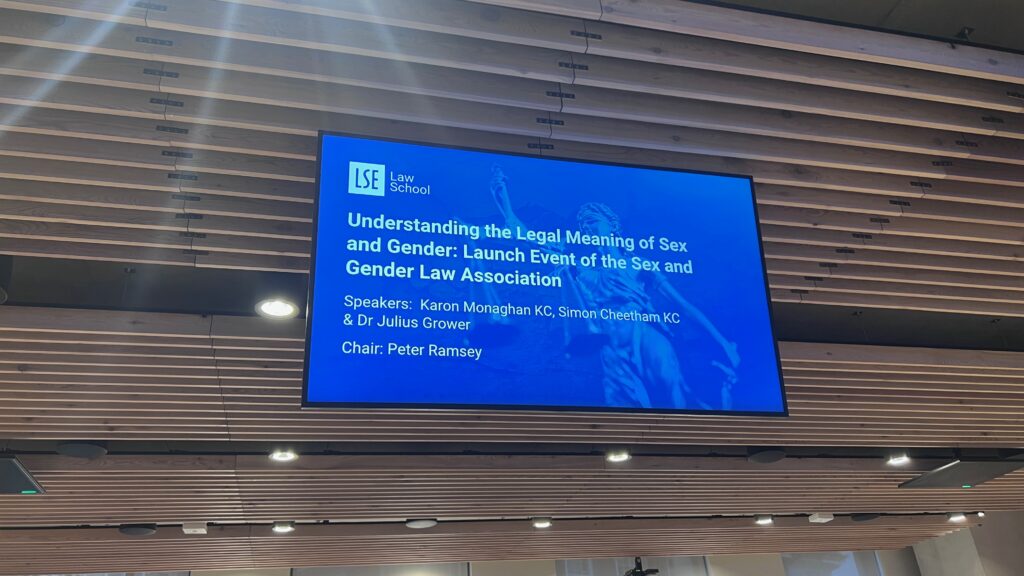
The questions after the talks were held under Chatham House rules (on the record, but unattributable) and mostly pertained to the application of settled law in a society where there is now entrenched cultural and political resistance to it. There were good questions around pronoun use – could a teacher compel a student to address them with their preferred pronouns (answer, no) – though forcing a teacher to address a student by their preferred pronouns (see Kevin Lister’s case) was not explored.
Inevitably, we touched on what I call the “bearded woman” question. The law now says that a male-presenting woman should use female toilets because she is female. However, it’s far easier for women to pass as men than vice versa, especially if they have facial hair. A “passing” woman – ie someone who at first glance looks like a man – could cause distress to other women using the female toilets (and other single sex facilities). According to EHRC guidance, this could be enough to prevent them from using the women’s spaces.
Whilst I don’t know a single man who would complain about a passing female using male toilets, that is now technically unlawful. One panel member said – as the EHRC guidance noted – this came down to a “case-by-case basis, so there shouldn’t be a general policy. And my view is that sounds right, because you can’t have a policy [which says] you look like a man so you can’t come in“. The panelist acknowledged this meant that a trans-identifying woman could be excluded from both male and female single-sex facilities, but “as the code also makes clear, people should not be left without a toilet to use at all.”
The final question perhaps got to the nub of it. The questioner raised the issue of the laws around religion. “I’ve met people with completely irreconcilable metaphysical beliefs”, he said. “Liberal society deals with that in relation to religion by having a whole load of areas where you don’t express beliefs, you hold back on expressing beliefs, you deliberately don’t see things… but I can’t see how that works here.” He acknowledged that “religion case law is a mess [and] the law is bad at grey areas”, but he wondered if the law related to sex and gender had “any scope for grey areas still…? Two years ago it may have been the case that people who passed… [other] people just looked the other way and let them use the facilities. That seems okay to me, but it doesn’t seem okay legally.”
One of the panellists sympathised, saying “I know! What happened to the good old days where you just thought, oh well… she’s very tall.” Cue more audience laughter. The other panelist said “There are grey areas. There will be workplaces because – despite what the law or the code says – there is (for example) a trans woman who will be using the toilet because there isn’t an objection… but I suppose that is a grey area socially… I don’t think there is a grey area legally.”
Boss Lady
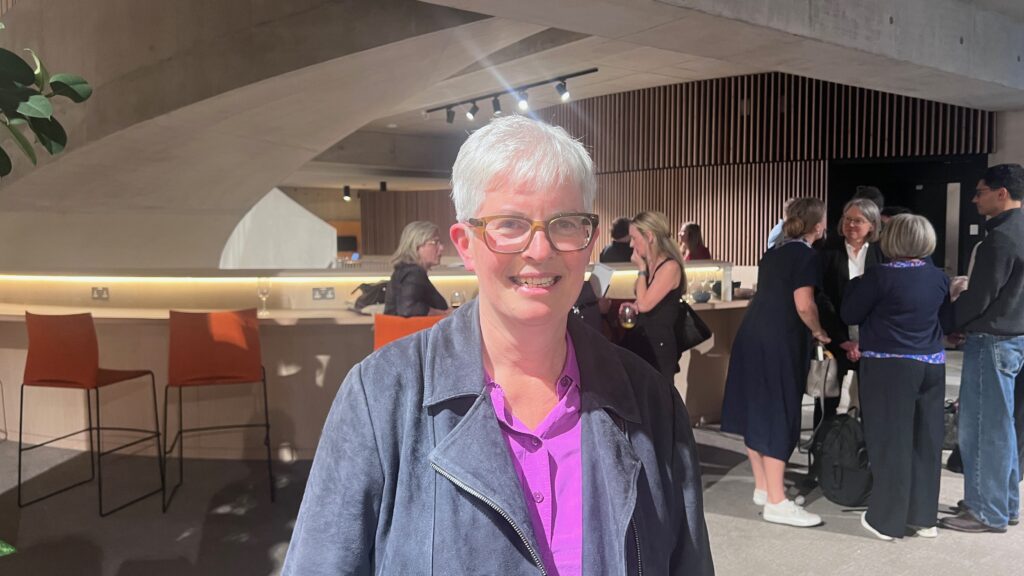
Afterwards I spoke to Naomi Cunningham, who set up the Sex and Gender Law Association, about her inaugural event. She said she “couldn’t be more delighted” with the way it had gone. “Actually getting people who don’t necessarily all agree about this in the same room and getting them to talk to each other like civilised grown-ups and that’s exactly what happened… no debate was the order of the day for much too long and this feels like a pretty important step in [the right] direction”.
Cunningham hopes the SGLA will be a good networking environment which achieves “mutual education, fundamentally. One of the things that’s interesting about these questions about sex and gender is that they cut across a very very wide diversity of different sorts of law and most of the people I talk to most are employment or public lawyers, but there are all sorts of other specialism which are going to be engaged [by this subject], criminal law, childcare law, professional negligence, regulatory law… and getting a whole bunch of lawyers with different specialisms who are interested in the sex and gender question together and getting them to compare notes and educate each other is, to my mind, a very interesting thing.”
My work on this website is entirely funded by donation. If you would like to make a one-off contribution and receive the Gender Blog newsletter and blog posts in your email inbox you can sign up here. Your email address will be stored securely and confidentially, never given to a third party and will only be used to inform you about things I think are interesting. If you have a story, please use the contact form. All messages go directly and securely to my email inbox and will be dealt with in the utmost confidence.


Leave a Reply