This is part two of my report into Day 4 of Nurse Sandie Peggie’s employment tribunal claim against the Royal College of Nursing. You can read Part 1 “Nurses Assemble”, here.
As with Friday’s cross-examination of Norman Provan, the interest is not in what the RCN man said in evidence, but the chain of logic that Sandie Peggie’s barrister Naomi Cunningham presented to Fraser, highlighting inconsistencies (and flat out misstatements of the law) in the RCN’s approach to gender issues.
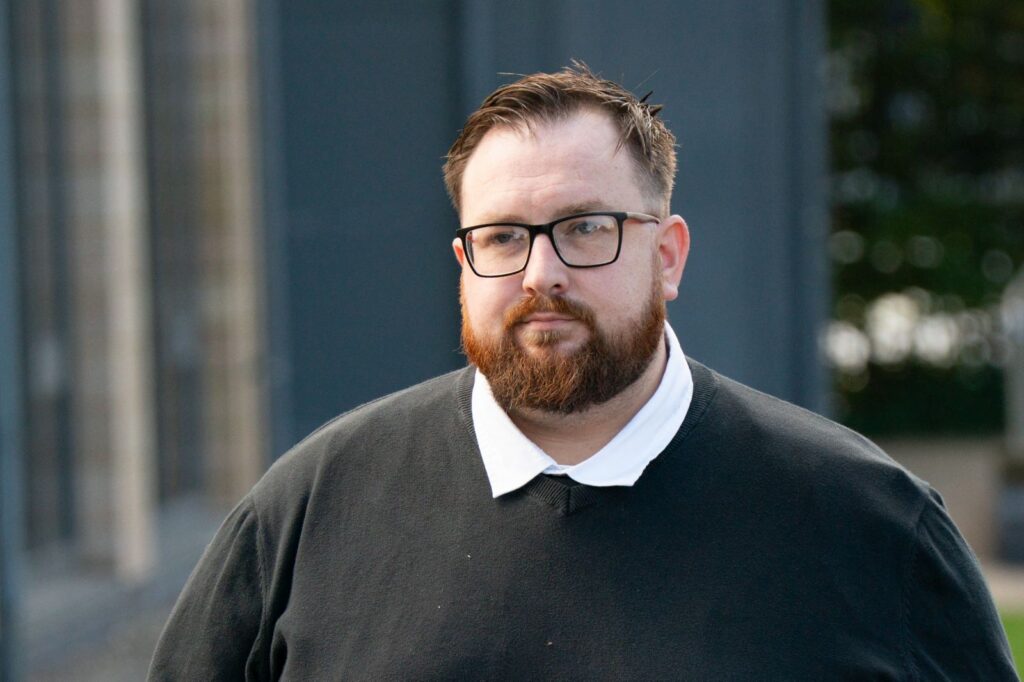
Stuart Fraser has been an RCN Officer for five years. He was the first representative Sandie Peggie spoke to on either the 5 or 8 January 2024 whilst she was suspended. Peggie had been told not to return to work after a confrontation on Christmas Eve with a trans-identifying male doctor in the female changing rooms where she worked at Victoria Hospital in Kirkcaldy Fife.
Fraser’s contemporaneous note of his first phone contact with Sandie Peggie was touched on by David Hay KC, the RCN’s advocate and then became the fundamental basis of Naomi Cunningham’s cross-examination. Here it is in full:
“called to member to discuss situation, member described that new doctor has started and they are a trans female and this has made members of staff uncomfortable as they are using the female changing area, member had discussed her discomfort with this, with her Line manager however nothing was done, member was in a level of discomfort due to bleeding and the DR was in the changing room, the member advised the DR that she did not think that she should be in there and said something along the lines of this is the same as when they put a man in a female prison, discussed with the member of the potential that this could be seen as discriminatory and is most likely what has caused the suspension. Discussed with member process of investigation and potential outcomes, et cetera advised will open case.“
Fraser told the court (whilst being prompted by Hay) that he usually took his notes whilst he was on a call with a member and that he thought his call with Peggie would not have been much more or less than 30 minutes long, which was a standard period for these sorts of calls. Fraser told Hay it was likely he would have spent the bulk of the call explaining the investigation process and how it could take 4-6 weeks to even start “depending on how many people they are investigating and how many witnesses they need to speak to”.
When asked about about his suggestion that Peggie’s comment about men in female prisons could be seen as discriminatory and that might be why Peggie had been suspended, Fraser said he had in mind the high profile Isla Bryson case. Bryson was a male rapist who had been put in a female prison in Scotland.
Cunningham asked Fraser what he understood about the Maya Forstater Employment Appeal Tribunal case in 2021. After a bit of prompting, Fraser remembered Forstater had taken action against “her university?”
“Kind of,” replied Cunningham helpfully “it was a think tank”.
“…and it was found her beliefs were protected in the same way race and religion were protected – a philosophical belief basically”, said Fraser.
Cunningham asked if Fraser had any training on this. He reckoned he had, in his quarterly sessions with Anderson Strathern, the solicitors with the RCN contract for conducting its legal affairs in Scotland (also representing the RCN in Peggie v RCN).
“Is that all you can remember on Forstater?” asked Cunningham.
“Off the top of my head and on the spot yes, sorry”, he replied.
Example 1
Cunningham took him to a two page article in the RCN magazine, dated September 2021. This is still available online. The article called the Forstater ruling:
“an important decision, but it does not mean that trans people are not protected under the Equality Act 2010. The EAT pointed out that it does not mean those with gender critical views can misgender trans people with impunity and it does not mean that employers will not be able to provide a safe environment for trans people. It does, however, demonstrate the extremity of beliefs that will be excluded from amounting to a belief with reference to the Equality Act.“
Cunningham asked if Fraser accepted this was a “grudging, minimising reading of Forstater, which places the emphasis on the ongoing protection for trans people”. Fraser was bewildered by the question and asked Cunningham to restate it. She did, saying “this is a reading of the judgment… whose main if not sole emphasis is that this doesn’t mean that this does anything bad to the protection of trans people. As opposed to – this is a powerful tool you can use to protect those with GC beliefs.”
“I see what you’re saying,” said Fraser. “It would be difficult to summarise Forstater in two pages, but I can see the point you’re making.”
Cunningham wondered if a fairer short summary of the judgment was: “This is an important decision that demonstrates the power of the EA to protect people with beliefs their colleagues might not like.”
“Potentially, yeah”, agreed Fraser.
“A powerful tool to protect members with those beliefs”, Cunningham re-phrased.
“That would be one way of looking at it, but I think the issues are a bit more complex,” said Fraser.
Cunningham broke it down. Asking Fraser to consider the two sides in a “bitterly contentious” debate. Adherents to genderism on one side and the gender criticals on the other. Could Fraser see that these were the “two sides of the debate that were engaged with Forstater”? He could.
“And Forstater says the gender critical side has powerful protection, which people didn’t understand they had – that’s the Big News isn’t it?” Fraser said he understood gender critical people were “always protected under the Equality Act”.
“I’m not suggesting they weren’t before, but lots of people didn’t know that”, said Cunningham.
Fraser agreed. Cunningham then asked him to agree that the tone of the RCN article didn’t suggest Forstater was Big News, rather it seemed to make the ruling “look like something that is a bit worrisome, that might be feared to diminish the rights of trans people”.
Cunningham read another passage in the article which quoted Forstater ruling where the panel of judges concluded “it is only those beliefs that would be an affront to conventional principles in a manner akin to that of pursuing totalitarianism, or advocating Nazism, or espousing violence and hatred in the gravest of forms, that should be capable of being not worthy of respect in a democratic society”. Cunningham suggested “the framing here makes gender critical or sex realist beliefs look eccentric and only a shade less toxic than Nazism.” Fraser felt that was her reading of it.
Example 2
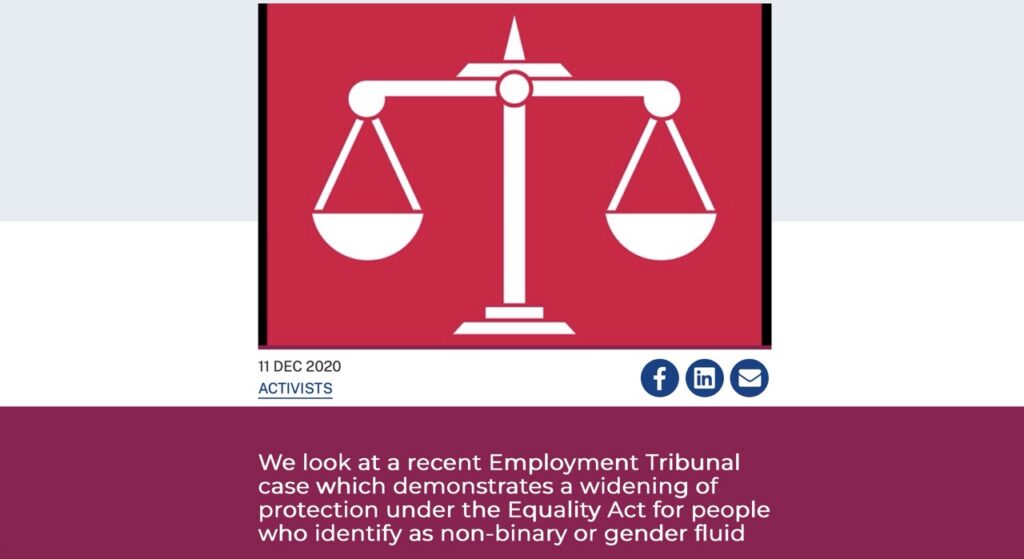
Cunningham then drew contrast with the RCN magazine’s 2020 reading of another judgment, this time Taylor v Jaguar Land Rover at a first tier employment tribunal. This too is still available online. The magazine tells us in this case:
“The claimant was employed by Jaguar as an engineer for 20 years and identified as non-binary at work in 2017. The claimant was subjected to abusive jokes, a lack of managerial support and experienced difficulties with toilet facilities and as a result, pursued claims of harassment, direct discrimination and victimisation on the grounds of gender reassignment in the Employment Tribunal.“
JLR argued that non-binary had no statutory definition and therefore, the case should fail. “However, the Employment Tribunal upheld all the claimant’s complaints and confirmed that the Equality Act does provide protection for those who identify as non-binary and gender fluid.”
This, said RCN was “an important decision for members as it represents a widening of the protection afforded by the Equality Act and, given that gender is a spectrum that continues to develop, these types of complaints may become more prevalent. This will be of assistance to RCN reps who are representing those who identify as non-binary or gender fluid in the workplace and should form part of the framework of any staff side discussions on diversity and inclusion.“
Cunningham compared the RCN’s treatment of a non-binding first instance tribunal ruling as “widening protections for trans and non-binary people” with its “almost dismissive” treatment of Forstater and its significance for sex realists:
“One is framed as a tool,” she suggested “and the other is framed as an odd decision about some nasty beliefs, but don’t worry the trans people are still going to be protected.”
“I see what you’re saying” said Fraser, “but i don’t agree with your assumption.”
Example 3
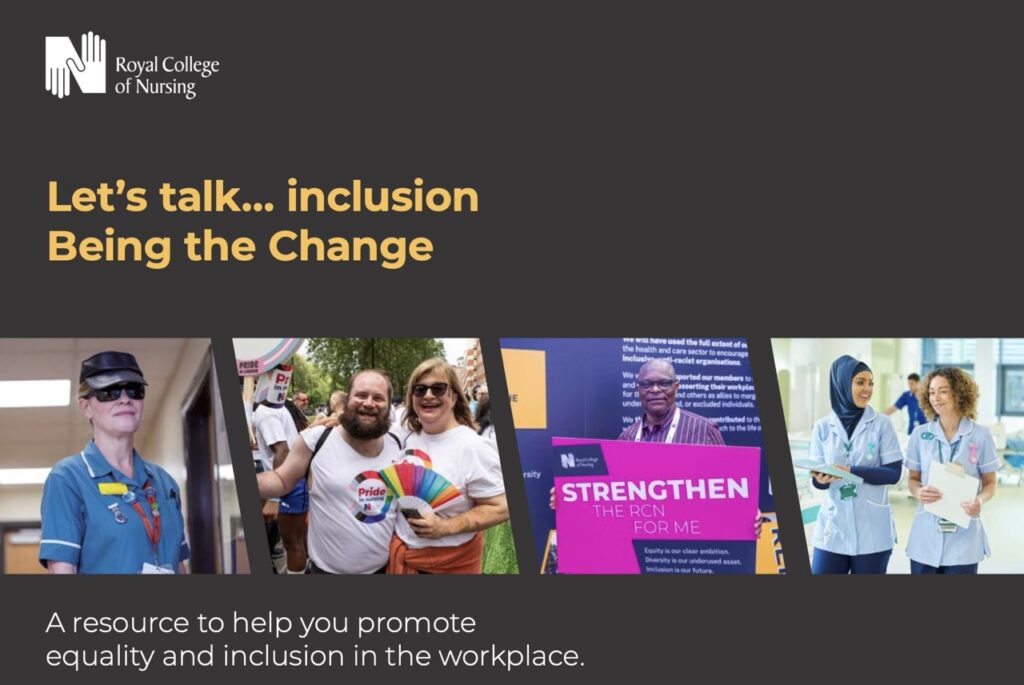
Cunningham took Fraser to another document which the RCN has removed from its website, but thanks to the wayback machine, is still available online and now uploaded here for safekeeping. This document is called “Let’s talk… Inclusion. Being the Change”
Cunningham noted this manual “rewrites the law” under the heading “Gender identity/gender reassignment” where it states: “The Equality Act 2010 provides protection from discrimination on the grounds of gender reassignment. Gender reassignment has been used as the legal term, but gender identity is the more inclusive term. In both cases, they refer to a person’s intrinsic sense of being male (boy or man), female (girl or woman) or another gender identity.”
“Gender reassignment remains the protected characteristic and gender is not a protected characteristic. That is the legal position isn’t it?” Cunningham asked.
“One more time”, suggested Fraser.
“Gender reassignment is the protected characteristic isn’t it?”
“Yes” replied Fraser.
“Saying that gender identity is the more inclusive term looks like an attempt to blend these?”
Fraser wasn’t sure that was the intent of the document.
Cunningham took him to a scenario in the same document in which a nursing colleague is “consistently using the wrong pronouns for this member of staff. This happens both with the person present and when they are not.” The advice for dealing with the scenario is to help the poor member of staff being misgendered and confront the misgenderer to say you have “noticed they are using the wrong pronouns” and “try and change this”.
Cunningham pointed out this operated on the assumption that misgendering someone was “bad and shouldn’t happen.” Fraser agreed that was the presumption. The same document had a section titled “Religion and belief” but completely ignored any gender critical beliefs. “It’s headed religion or belief and then just talks about religion or lack thereof” said Cunningham.
The person writing the RCN document did appear to be aware of political opinion being protected, in law, but wrongly stated that this was “unique to Northern Ireland”.
As a whole, said Cunningham, there was nothing in the RCN’s literature “to give the impression that RCN is keen on the protection of gender critical or sex realist beliefs.” Fraser agreed there was nothing in the “Let’s talk… Inclusion” document which made reference to it, but that he couldn’t speak for the RCN as a whole.
The Fix Is In
Cunningham said her point was that the RCN had let Fraser down in failing to equip him with the legal knowledge necessary to properly advise Sandie Peggie. We turned back to the notes of the first call made in early January 2024 and its last few lines: “discussed with the member of the potential that this could be seen as discriminatory and is most likely what has caused the suspension“.
Cunningham said “It is clear from your evidence that what might be discrimination was a trans woman in the changing room.”
Fraser again disagreed saying “no… in relation to the wording this is like having a man in a woman’s prison. From my understanding that could be seen to likening Dr Upton to a rapist which Isla Bryson was.”
Fraser agreed he thought the discrimination mentioned in his note was probably gender reassignment. Peggie had said what she said “because of the presence of a trans woman”. If there was a woman present who wasn’t trans, Peggie would not have made the remark.
Fraser agreed.
“It’s clear isn’t it, that it didn’t occur to you at the time that she might have suffered harassment as a result of Dr Upton’s use of the changing room” asked Cunningham.
“No because my understanding at the time was the guidance”, replied Fraser. “My understanding was that trans individuals could use the facilities with which they identified.”
Cunningham reminded Fraser that “the kind of discrimination you were thinking of when you thought it could be seen as discrimination was gender reassignment”. That had to involve “an analysis or comparison of how Sandie Peggie treated a trans woman and a woman who wasn’t trans.”
Fraser agreed.
“That proceeds on the basis that Dr Upton was a type of woman”, said Cunningham
“I believe that Dr Upton believes she is a woman,” replied Fraser.

What about, wondered Cunningham, the “alternative view”, that Dr Upton was “not a kind of woman, but a kind of man”.
Spelling it out, Cunningham said: “The gender ideology analysis would be that Dr Upton is a kind of woman, so [Peggie] has treated him differently because he is a trans woman.” Whereas a gender critical analysis would say “he’s a man [and] treated differently because he is a man.”
“Yeah”, said Fraser, acknowledging the logic.
“Dr Upton is a kind of man”, concluded Cunningham.
Fraser was now forced into a corner.
“Under the Equality Act, yes he would be,” he replied. “The protections refer to biological sex at birth.”
But, said Cunningham, “you failed to advise Sandie Peggie on potential discrimination claim she had because the prevailing culture was gender ideology and it required you to approach [her case] on the basis Dr Upton was a kind of woman.”
Fraser disagreed. He said he looked at the information he was given and “it would be very unusual for me to make a referral to a solicitor after an initial call without additional evidence, or a right of reply.”
Cunningham, took Fraser back to his call note. Fraser readily acknowledged that Sandie Peggie had referred to Dr Upton using masculine pronouns. “You’ve edited that in your reporting of that she said and subbed feminine pronouns haven’t you?” asked Cunningham, referring to the sentence: “she did not think that she should be in there“.
“If it’s there, then yes”, said Fraser, with a minor gesture of exasperation.
“Doesn’t that little substitution of ‘she‘ rather clearly give the game away that you were taking the opposing position?” asked Cunningham.
“I wasn’t treating Dr Upton as anything”, replied Fraser. “I was just typing the note from the call, and I don’t think I would have thought of it if I am honest.”
“Gender ideology had got its hooks in so deeply that you subbed the pronoun because you knew – even subliminally – you knew it would be unacceptable to report Sandie Peggie’s use of correct sex pronouns.”
Fraser had a go at suggesting it might be typo, before again claiming he hadn’t really given the whole thing much thought. He denied treating Sandie Peggie as the aggressor on the basis she had discriminated against a trans person and reiterated his idea that she was a victim based on the fact she had complained to her employer about the changing room situation on two occasions previous to the confrontation and nothing had been done.
People Just Do Nothing
Cunningham noted that NHS Fife had introduced a policy which allowed a male to use the female changing rooms without any risk assessment, impact assessment or consultation. She thought that any union “worth its salt” would be up in arms at this “high-handed behaviour”. Why hadn’t the union got involved? Fraser thought it was the lack of clarity about the interpretation of the law, as handed down by previous iterations of the EHRC guidance which, he suggested seemed to make it all a bit of a “grey area”.
Cunningham ungreyed it for him. “Do you accept that women are entitled to male free spaces when they take their clothes off?” she asked.
“Of course they are, yes.” he agreed.
“Sandie Peggie’s employer had decided they weren’t entitled to that.” said Cunningham, and once more, Fraser was off.
“That is on the understanding that trans women aren’t women, and I don’t think the board would have taken that view at the time”, he replied.
“But the board and the employer just unilaterally decided to take away the rights for single sex changing rooms. You thought that was okay?” challenged the barrister.
“I don’t believe that they did do that”, tried Fraser.
“Dr Upton was using it.” said Cunningham. NHS Fife’s decision had unlawfully deprived women of female only changing “with no consultation, and RCN wasn’t outraged?”
Fraser pointed again to the EHRC guidance which would have given NHS Fife the “belief” that Dr Upton could use the female changing room.
“And it would have been your job to challenge that”, said Cunningham. But Fraser didn’t seem to think it was – not even to go and meet Sandie’s colleagues, have some private chats with them to see how they felt about it all.
“No I didn’t, no.” he said.
Fraser’s evidence continues tomorrow.
Peggie v RCN preview interview
Peggie v RCN Day 1: Getting Taken Seriously
Peggie v RCN Day 2: Trans-Organisational Madness
Peggie v RCN Day 3: unProvan
Peggie v RCN Day 4 Pt 1: Nurses Assemble
Peggie v RCN Day 4 Pt 2: Stuart Fraser
Day 1 Live Tweets Collated
Day 2 Live Tweets Collated
Day 3 Live Tweets Collated
Day 4 Live Tweets Collated
Fair Care For Trans Patients 2nd Edition – RCN
Let’s talk… inclusion: Being the Change – RCN
Thanks to everyone who has contributed to help fund my reporting of this court case. I am live-tweeting each day in court and publishing reports after each day’s proceedings. Subscribers get a special subscriber-only newsletter after each day’s hearing (once I’ve got a report up on the website).
If you would like to receive the GenderBlog newsletter and blog posts in your email inbox for a small monthly or one-off donation you can sign up here. Your email address will be stored securely and confidentially, never given to a third party and will only be used to inform you about things I think are interesting. If you have a story, please use the contact form. All messages go directly and securely to my email inbox and will be dealt with in the utmost confidence.


Leave a Reply