

I want to focus my Day 3 report on a specific passage of cross-examination which to my mind went beyond the (undoubtedly very important) rights and wrongs of Sandie Peggie’s claim against the RCN. It demonstrated the effectiveness of using a courtroom to hold power to account.
Norman Provan was today’s only witness. He is the Royal College of Nursing’s Associate Director for Employment Relations and he has been in the job for 18 years. He sits on the senior management board of the RCN and reports directly to its executive director. He is a big man in the world’s biggest nursing union. What he says, on the record – and on this occasion – on oath, matters.
Provan finished his evidence in chief this lunchtime with a bold statement. David Hay KC, the RCN’s barrister, had spent the best part of two hours gently taking Provan through his and the RCN’s decision-making procedures to demonstrate that the RCN’s governance was good, its processes were sound and the policies it implemented were right-thinking, legitimate and reasonable. Hay’s final question was to ask Provan about the RCN’s “corporate position” on gender ideology and how it might relate to individuals who hold Gender Critical or Sex Realist beliefs.
Provan told the court: “I am aware this has been a contentious issue among members with views strong views on both sides. From a corporate organisational side I have never in my role as a senior manager had any impression that the RCN prefers one side over the other. We provide support to people whose rights are protected under the Equality Act and I have never encountered anything in the organisation which suggests other than that.”
Let’s Test That Against The Evidence, Shall We?
After lunch, Sandie Peggie’s barrister Naomi Cunningham walked Provan through the salient points of what Cunningham called Gender Identity Ideology (GII) and Gender Critical or Sex Realist perspectives.
Provan was familiar with the GII mantra “trans women are women, trans men are men and non-binary identities are valid”. He also accepted the concept behind it, which was, in Cunningham’s words “whether someone is a man or a woman and should be treated as a man or a woman, is down to their inner belief about their gender identity”. He agreed the gender critical perspective was that sex – ie whether you are a man or a woman – is defined by your body.
Cunningham took it a step further with what she admitted was a “slightly cartoonish” proposition – that GII adherents say trans women are women and gender critical people say trans women are men. Provan was happy to accept this as uncontroversial.
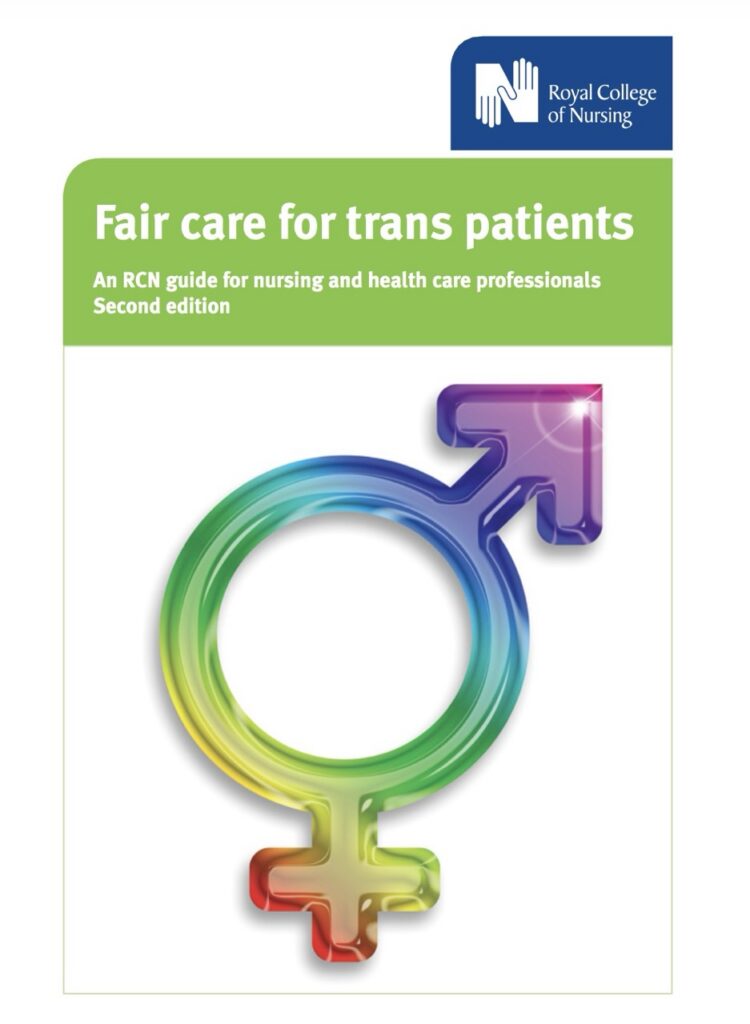
Cunningham asked Provan to look at a document called “Fair care for trans patients” first published by the RCN in 2016. It is described as “an RCN guide for nursing and health care professionals”. You can read the full document in the link at the bottom of this article.
The guide is unequivocal: “Where trans patients are cared for in an inpatient setting, care should be taken to meet their needs for privacy and dignity whilst an inpatient. Patient placement should be based on both asking the patient for their preference, and on gender presentation.”
Cunningham put it to Provan that the clear implication of this was “a man dressed as a woman, who says he’s a woman, should be placed on a female ward?”
Provan gestured rather helplessly at the document and said “Yes.” Cunningham suggested that this RCN document was therefore unequivocally aligned with trans ideology.
Ah, but… Provan argued – this was not policy – this was mere guidance for nurses, published prior to the Supreme Court judgment which cleared everything up for everyone. Cunningham made the point that the Supreme Court judgment didn’t appear out of nowhere. It only came about because of the dispute between the gender identitarians the sex realists, and the RCN advice was “manifesting a commitment to gender identity beliefs”. Provan accepted that was indeed the case.
Cunningham took him to the section of the same guide which deals with trans children, it says: “Gender-variant children and young people should be accorded the same respect for their self-defined (or true) gender as trans adults are, regardless of their genital sex… Where segregation is needed, then this should be in accordance with the dress, preferred name/and or stated gender identity of the child or young person.”
This, Cunningham said, was a policy of “affirmation of expressed gender identity” which suggests nurses should treat children as the opposite sex if they say they are. Provan accepted it was. Cunningham asked if he accepted that it was an expression of gender identity belief. Provan said it was guidance on how to treat people with dignity and respect.
“Guidance which reflects the RCN’s position at the time?” asked Cunningham. “Yes”, said Provan. Therefore, suggested Cunningham – it was the RCN’s view.
“I think it’s fair to say yes to that,” said Provan, wriggling a little.
You… what?
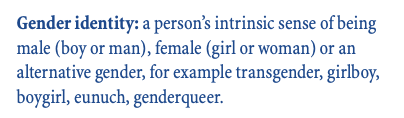
Before moving on, possibly to make him wriggle a little more, Cunningham took Provan to the glossary of terms at the back of the document. The glossary is introduced with the words “The language, labels and terminology used by trans people to describe their experience and their true gender identity remains dynamic and highly contextual rather than static and fixed. This list is not exhaustive but intends to provide a brief overview of some of the terms that you may encounter in your role as a nursing and health care professional.”
There are many points that can be made about a belief system where meaning is apparently derived from moving definitions of slippery and chimeric concepts, but Cunningham preferred to focus on the entry in the glossary headed Gender Identity. This gave examples of gender identity, such as “male (boy or man), female (girl or woman) or an alternative gender, for example transgender, girlboy, boygirl, eunuch, genderqueer”.
“Eunuch…” mused Cunningham. Was this not, she asked, getting into the realms of some of the “wilder shores” of gender ideology?
Provan said the document and glossary was more about helping nurses understand some of the language being used around the subject. “So is your evidence to the tribunal”, asked Cunningham, “that the gender identity eunuch is a valid identity that should be used and respected by healthcare staff?”
Provan again said he thought the point of the glossary was to help nurses understand some of the language being used at the time. Cunningham asked if a child presented as a eunuch, should nurses treat that child as a eunuch?
Provan wasn’t sure this was about children. Cunningham drew it all together – arguing that as a whole – the RCN guidance said:
- adults should be allowed to be put into the wards of the sex they said they were and treated as such,
- children should be treated the same as adults and that
- any child presenting as a eunuch they should be affirmed as such.
“Shocking, isn’t it?” asked Cunningham. Provan was not going to agree to that, again saying it was about helping nurses understand the language around the subject, but the point had been made to the court – the RCN really did go through a phase of drinking in the woo
Campaigning Tat
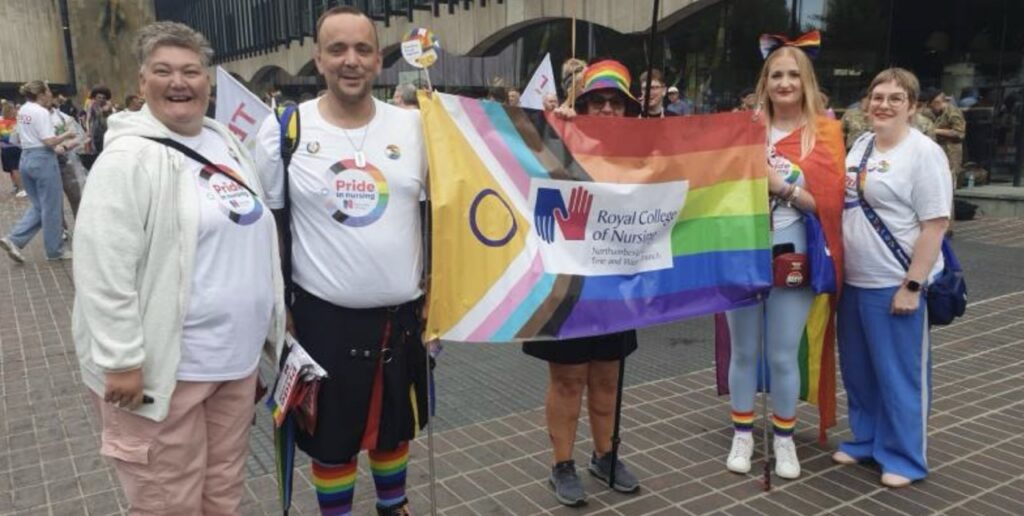
Cunningham wasn’t finished. She took Provan to a news article published on the RCN website this year about its attendance at Northern Pride which had a photo of some people standing with an image of the RCN logo embedded into a Progress Pride flag. Cunningham asked if Provan accepted the progress flag was “firmly associated” with GII. Provan accepted it was. “So the RCN is associated with gender identity ideology – celebrating it?” asked Cunningham. Provan again agreed.
Cunningham wondered if the RCN had ever promoted a gender critical event. Provan wasn’t sure.
“Hazard a guess”, suggested Cunningham.
“Are you aware of any?” asked the judge.
Groping for answer, Provan burbled about events hosted by the RCN which had been held to mark the achievements of the suffragettes. Cunningham heard him out and then asked him to accept there was a “sharp and obvious” distinction between the campaign to give women the vote and the importance of recognising that the difference between the sexes is real and important?
Thankfully, Provan did. In passing, Cunningham did acknowledge that the GC movement had taken on the suffragette colours, which came as news to Provan. He genuinely seemed to have no idea that GC campaigners often wore purple green and white. He didn’t know the GC movement had colours.
Dragging him back on track Cunningham suggested it would be “inconceivable” that the RCN would hold an event celebrating gender critical views. Provan disagreed. Cunningham said she was sure that if there ever had been an RCN GC event, his colleagues testifying next week would bring along the evidence.
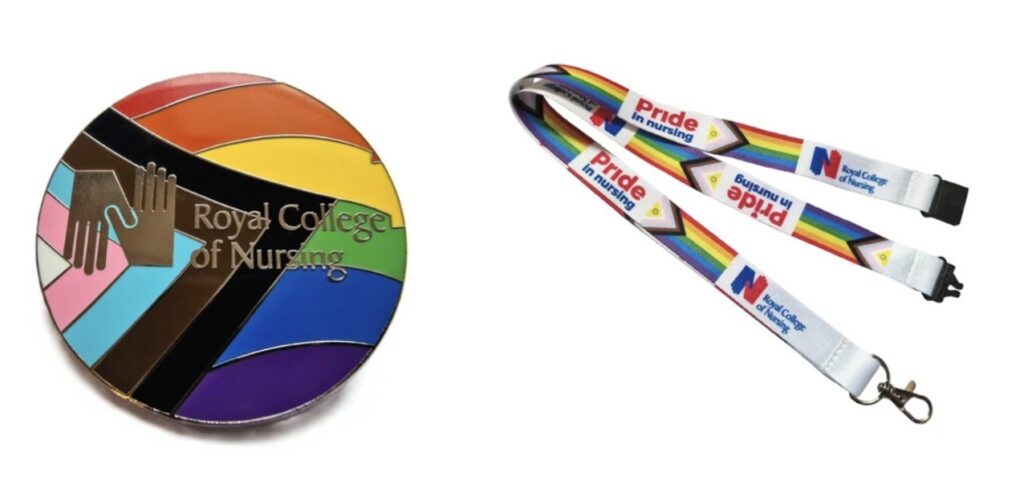
Cunningham had one more general example to make – she showed Provan pictures of the products on display in the RCN online shop. There was a Progress Pride RCN enamel badge and a Progress Pride RCN lanyard. Cunningham wondered why only one belief – gender ideology – had found its way into the “campaigning tat” in the RCN shop. Where was the gender critical tat, the atheist tat, the religious tat? Why had one belief been privileged to the exclusion of any other? Why wasn’t there a gender critical badge or lanyard? Provan wasn’t sure, but suggested – now that he knew the GC movement had colours – if someone were to incorporate those colours into the Progress Pride flag and produce a badge containing the new flag, the RCN shop would stock it.
With ideas like that, it’s no wonder Provan has risen to such giddy heights. Cunningham mused for a moment on a “parallel universe” whereby gender critical views could be the next cause to be added to the Progress Pride rainbow. Surely Provan knew that was a “never going to happen”? He didn’t think so. Cunningham asked if someone did design and produce an RCN badge in the gender critical colours, the RCN shop would stock it. Provan said he would “expect” that to happen.
Watch this space.
A Misogynistic Creed

Having essentially got her witness to accept that the supposedly neutral RCN had endorsed guidelines wedded to gender ideology and continued to celebrate it, without coming up with a scrap of evidence it had offered the same courtesy to its gender critical members and employees, Cunningham suggested that notwithstanding the RCN’s supposed neutrality, it had “tacitly” adopted gender ideology.
This, she suggested, was dangerous, because gender ideology, is – at the sharpest and most contentious end – about privileging the rights of a small minority of men over women, something which leads to male rapists being housed in female prisons, men being appointed to run rape crisis centres and male patients on female wards. “It puts a high value on the rights of men who say they are women, and little to no value on the needs of women”, suggested Cunningham. “That could be argued”, agreed Provan, but he refused to accept Cunningham’s next proposition which called this a “misogynistic creed”.
Provan argued there was a breadth of circumstance between the conniving male rapist seeking to be accommodated with vulnerable females and a man who might have lived many years “as a woman”. Provan wasn’t sure misogyny was a common thread.
But that was the “fundamental problem” with the creed Trans Women Are Women, said Cunningham. It doesn’t distinguish between the “harmless men… living under the radar” in their lady garments and the “fetishists, perverts, predators and chancers” who fall under the same TWAW definition. On that point, Provan and Cunningham were agreed.
Cunningham then took Provan to Bruce Carr KC’s devastating 2022 report, which concluded that at senior management levels the RCN was “riddled with division, dysfunction and distrust.” Cunningham drew Provan’s attention to the fact that despite having a 90% female membership, the RCN’s ruling Council was 60% male and perceived as a “misogynistic environment in which loud and abrasive male voices dominate the environment to the detriment of women.”
Cunningham said this was consistent with an organisation which “privileges the rights of men above women” – the inference being it was no wonder the misogyny of GII had taken hold so effortlessly.
Provan did not agree, but Cunningham had made her point.
Whether or not this lands with the judge felt momentarily irrelevant. Of course it matters what the judge eventually rules, and it matters more than anyone to Sandie Peggie, whose life was turned upside down more than three years ago when her employer introduced an unlawful policy into the workplace without any of the normal checks and balances that would be expected with something far less radical.
However – what we saw today was the admission from a senior executive that his union had taken an irrational position on an irrational ideology without ever being able to admit as much, until this afternoon, when it was forced to, by the evidence presented to it in court.
Peggie v RCN preview interview
Peggie v RCN Day 1: Getting Taken Seriously
Peggie v RCN Day 2: Trans-Organisational Madness
Day 1 Live Tweets Collated
Day 2 Live Tweets Collated
Day 3 Live Tweets Collated
Fair Care For Trans Patients 2nd Edition – RCN
Thanks to everyone who has contributed to help fund my reporting of this court case. I will live tweet each day in court and publish reports after each day’s proceedings. Subscribers will get a special subscriber-only newsletter after each day’s hearing (once I’ve got a report up on the website).
If you would like to receive the GenderBlog newsletter and blog posts in your email inbox for a small monthly or one-off donation you can sign up here. Your email address will be stored securely and confidentially, never given to a third party and will only be used to inform you about things I think are interesting. If you have a story, please use the contact form. All messages go directly and securely to my email inbox and will be dealt with in the utmost confidence.


Leave a Reply