
The British Association for Behavioural and Cognitive Psychotherapies (BABCP) has proposed requiring its therapists to “actively promote inclusion” during therapy sessions and “ensure that any discriminatory attitudes and behaviours are challenged” when expressed by patients.
The BABCP regulates psychotherapists and BABCP accreditation is considered important for any Cognitive Behavioural Therapist (CBT) working in the NHS. It has more than 23,000 members. The new requirements are part of a proposed overhaul to the BABCP’s Standards of Conduct, Performance and Ethics, which, if approved, will come into force later this year.
The standards tell therapists that “discrimination can be challenged by speaking up… it may be possible to ask for a change of behaviour, provide accurate information to dispel stereotyping, misconceptions or generalisations, or to provide resources to educate and explain why it is harmful.”
The proposals have outraged some BABCP members, with one therapist saying Standard 1, which incorporates the above requirements, is “based on identity politics, lacks neutrality and clarity, promotes un-therapeutic behaviours and is inappropriate for the BABCP, a supposedly scientific organisation.”
Susan Forbes is a BABCP member and has been a psychotherapist for 25 years. She has worked with detransitioners and individuals with what she calls “gender distress”. Forbes tells me “there is a great difference between not discriminating against a client and being required to challenge discriminatory attitudes. A CBT therapist might want to explore how an expressed discriminatory belief relates to the client’s difficulties, but that is very different from the therapist having an externally imposed obligation to ‘challenge’ the attitude, which conflicts with the fundamental CBT principle of collaborative empiricism.”
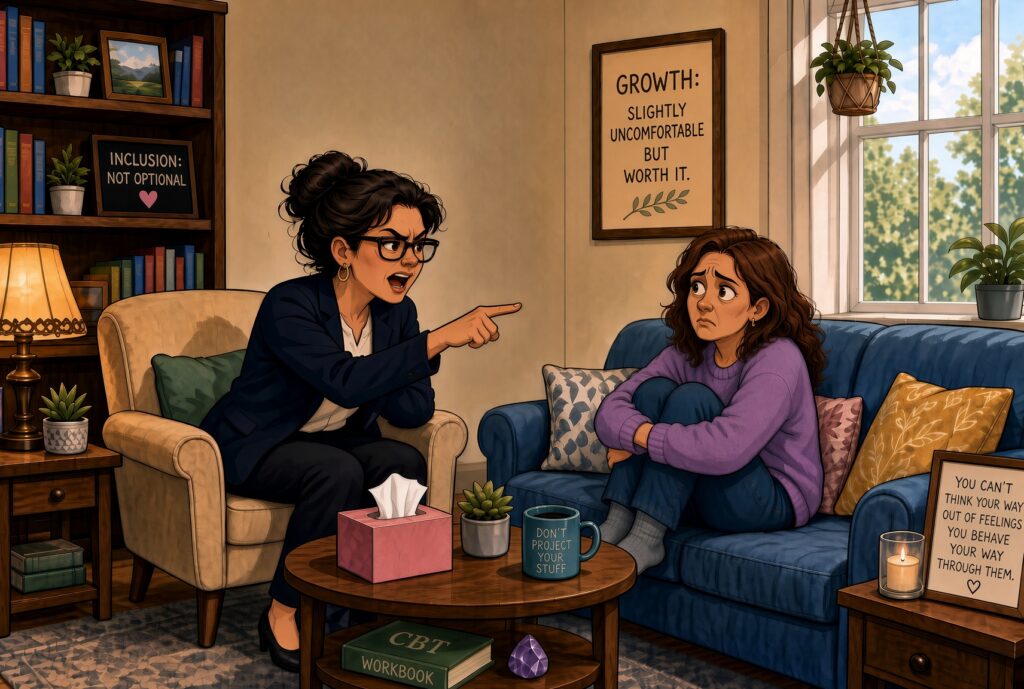
Avy Joseph is the co-founder of the College of Cognitive Behavioural Therapies. He says, “consider two therapists with opposing views on sex and gender identity. Is a gender-critical therapist required to challenge a client’s belief in gender identity? Is a therapist who accepts gender identity required to challenge a client’s gender-critical beliefs? If only one of those positions is considered discriminatory, on what professional or evidential basis has that judgement been made?”
The current Standards, approved in 2012, tell therapists “you must not allow your views about a client, patient or service user’s characteristics to affect the way you treat them or the advice you give. Some characteristics are legally protected. You must not assume that service user characteristics, protected or otherwise, are inferior to others and must not seek to change or suppress them on that basis.”
Dangerous
The problems with the new Standards is compounded by another requirement in Standard 1, which tells therapists they “must not attempt to change, coerce, suppress, or manipulate an individual’s identity, faith, philosophical, religious or political beliefs or any other protected characteristic.”
This clause appears to be in conflict with the clauses requiring therapists to challenge their clients. As one BABCP member tells me:
“Suppose a client holds a sincerely held religious or philosophical belief that the therapist, BABCP or another person considers discriminatory. What exactly is the therapist required to do? If the therapist challenges the belief, offers education and attempts to persuade the client that the belief is harmful, at what point does that become an attempt to change a protected belief, which the following standard expressly prohibits? Conversely, if the therapist respects the client’s belief and does not attempt to change it because doing so is irrelevant to the agreed therapeutic goals, could the therapist then be accused of failing to challenge a discriminatory attitude? The therapist therefore appears potentially caught between two competing professional obligations: do not attempt to change protected beliefs, but do challenge beliefs considered discriminatory.”
As my source points out “This is not an obscure theoretical problem. Religious and philosophical beliefs frequently concern sex, sexuality, gender, marriage, family structures, morality and other subjects on which profound disagreements exist within a pluralistic society. Some of those beliefs may qualify for legal protection even where other people regard them as offensive or discriminatory.”
Forbes calls the proposed ban on challenging beliefs “dangerous”, because “it makes it impossible for the therapist to work in the client’s best interest. We cannot offer effective therapy if we treat every aspect of their self-concept as immune from therapeutic examination or change.”
Colin Lenton, another BABCP member agrees: “We cannot be good therapists or counsellors without inviting our clients to explore where their feelings and beliefs come from, not to just accept everything the client says as true. We all change our minds about lots of things. If i believe something that is going to lead me to cut off body parts or go on life-changing hormones and drugs for the rest of my life, it is not care for a therapist to just accept that without inviting me to be clear in my mind that I know and understand where these thoughts come from, and if they are indeed what I want or what is best for me.”
The Fear of Misgendering
The requirement to “actively promote inclusion” seems to be politically loaded. In the proposed Standards, “inclusion” is defined as “working towards and maintaining environments where everyone – regardless of background, identity, or ability – is welcomed, respected, and supported to participate as fully as possible”. On the current BABCP website page Why Pronouns Matter, inclusion seems to mean something different. Under the heading Creating an Inclusive Environment, the BABCP tells its members “We encourage all members of the BABCP to share their pronouns in their email signatures, on name tags at events, and in introductions. This not only helps normalise the practice but also alleviates the fear of misgendering someone. It’s a simple step, but a powerful one in creating an inclusive environment.”
Dr Carole Sherwood, a retired clinical psychologist who runs the campaign Save Mental Health and remains a BABCP member, says on this point, the proposed Standards “do not differentiate between adults and children. The use of pronouns with gender questioning children could be viewed as an attempt to facilitate social transition – which is against the recommendations of the Cass Review.”
The BABCP has “scientific research and the application of evidence based practice” as one of its founding principles, but a number of BABCP members are concerned the organisation has been moving away from those principles and towards unscientific activism. Whilst the organisation could not muster a response to the Cass Review, when the For Women Scotland Supreme Court ruling landed in April 2025, the BABCP put out a statement saying it was “concerned about the impact” the judgment would have “on mental health and wellbeing for trans, non-binary, intersex, gender-questioning people (TN-B/I) and those close to them”. It then descended into a kind of word soup about “biological determinism”, asserting that the ruling could be “questioned on grounds that it does not take into account scientific understandings of gender diversity and could cause harm to TN-B/I people.”
The statement finished by listing sources of “support”, which started with Mermaids, and included GIRES, the LGBT Foundation, the Good Law Project and TransActual.
Beautiful Eco-Distress
In November 2025, the BABCP published a Climate Change Guide to help therapists treating patients with “eco-distress”. The document included a BABCP statement telling its members “we are in a climate and ecological emergency” and urging them to “take action on climate change. Whether this is within management, leadership, research, training or the clinic.” The guide also describes eco-distress as a “beautiful, ethical, and appropriate human response” to our warming planet, and says therapists “must not try to change” anyone expressing it, even children.
This prompted a complaint from Dr Sherwood who wrote to the BABCP trustees in February this year, telling them: “young children have been exposed to rather too much adult catastrophising and preoccupation with climate change, and this has likely led to unnecessary anxiety and distress. The idea that they should be encouraged to wallow in despair is frankly irresponsible. Has no-one at the BABCP ever paused to consider whether its own catastrophising language and behaviour may be contributing to and maintaining people’s distress about climate change?”
Taking aim at the document as a whole, Dr Sherwood said “The widespread use of political and hyperbolic language and calls for positive action throughout this guide indicates that it is an activist-led rather than clinically informed document. Calls to go ‘beyond scientific evidence’, to turn to ‘indigenous wisdom’ and to transform ‘the current economic system’ should be anathema to an organisation promoting an evidence-based talking therapy, not economic change or environmental activism.”
In March this year, Susan Forbes also lodged a formal complaint, telling the BABCP trustees she was “increasingly concerned that the organisation has moved away from its stated purpose of advancing cognitive behavioural therapy through scientific research and evidence-based practice. Recent developments reveal a shift toward the adoption of ideologically-driven frameworks that are not grounded in a robust evidence base and which many members would dispute on clinical, ethical, and scientific grounds.”
Sherwood echoes Forbes’ concerns, telling me: “When I rejoined as a member last year I was dismayed to witness the extent of activist influence and decision-making based on EDI rather than clinical principles. Although other professional organisations (BPS, BACP) have fallen to activism, I thought CBT would be the last bastion to hold out against politicisation but I was wrong.”
Whilst eco-guides and website posts on the fear of misgendering are one thing, the proposed new BABCP Standards are another. They are the rules by which all members must operate. Therapists can be investigated and disbarred if they are found to have breached the Standards.
When approached about the controversial clauses in Standard 1, the BABCP told me it had “held a widely-publicised six-month long consultation process which gathered hundreds of responses from members and stakeholders. The clauses you reference were part of that consultation and concerns about their interpretation or application were precisely the kind of feedback the process was designed to capture. The consultation closed at the end of July and the wording of the Standards is now being finalised in light of all the feedback received. On the specific tensions you identify between clauses 1.4 and 1.5 [the requirements to challenge attitudes and behaviours whilst also not trying to change protected beliefs] this is a question of the interpretation of professional standards and the consultation was designed to address that. As the wording has not been finalised, it would not be appropriate to comment further.”
The BABCP further affirmed its commitment to “the safety, quality and accessibility of evidence-based psychological therapies for all people who need them, regardless of their identity or beliefs as well as supporting our members to practise to the highest professional standards.”
The final draft Standards will go to the BABCP board for approval in September before being voted on by members later this autumn.
My work on this website is entirely funded by donation. If you would like to make a one-off or regular monthly contribution and receive the Gender Blog newsletter and blog posts in your email inbox you can sign up here. Your email address will be stored securely and confidentially, never given to a third party and will only be used to inform you about things I think are interesting. If you have a story, please use the contact form. All messages go directly and securely to my email inbox and will be dealt with in the utmost confidence.


Leave a Reply