
This article may be better understood by reading yesterday’s report which also includes a backgrounder explaining how this case came to court: Sex Matters v CPS Day 1: Is the CPS Guidance on Sex by Deception Lawful or Not?
The following is a report of the second and final day of Sex Matters’ attempt to have the Crown Prosecution Service’s current guidance (the Guidance) for Prosecutors on sex by deception ruled unlawful. Today’s judicial review hearing ran for just over two hours. It started by allowing Clair Dobbin KC (who I last saw representing Gareth Jenkins at the Post Office Horizon IT Inquiry) to respond to the detail of Sex Matters’ claims that the Guidance is unlawful and so confusing it might lead to crown prosecutors making the wrong charging decisions.
(If you would like to read my live tweets from today in a formatted, time-stamped, fully searchable web-page, please do go to the live tweets on this website which records any live-tweeting I do in real time and then turns them into a lovely archive for your reading pleasure.)
Design for Life
Yesterday Sex Matters said that the more convincingly a trans person has concealed their sex, the more the onus on the them to ensure any likely sexual partner is aware of it. Dobbin said it is not for the Guidance to provide “a framework for living”. Its purpose is to guide crown prosecutors as to whether there might have been a criminal offence. Besides. the Sex Matters point is covered where the Guidance states “if you fail to disclose your sex or gender identity that might make you criminally liable.” Dobbin felt that was “the correct balance given the nature of this Guidance… it’s not there to act as some guide for how people should conduct themselves.”
Dobbin then addressed the central point made by her client, the Director of Public Prosecutions, who believes that gender identity is a reasonable and relevant consideration for prosecutors when it comes to consent, sex and charging decisions. Dobbin pointed out there was no settled law in this area. She gave the example of a young (presumably passing) trans woman (to use her language) kissing a young man at a disco after dancing together, but not exchanging a word “in the way that young people do”. What consent has the young (possibly heterosexual, possibly not) man given in that instance? Has the trans woman committed an assault by deceiving the man? Dobbin told the court: “We don’t know whether that would constitute a criminal offence”.
Dobbin said the Guidance was not making a direction one way or the other in a case like this. If it did “that might be an issue”. Instead it simply flags up that there are “situations prosecutors might be confronted with”, but the Guidance is not saying these cases should not be prosecuted.
No Sympatico
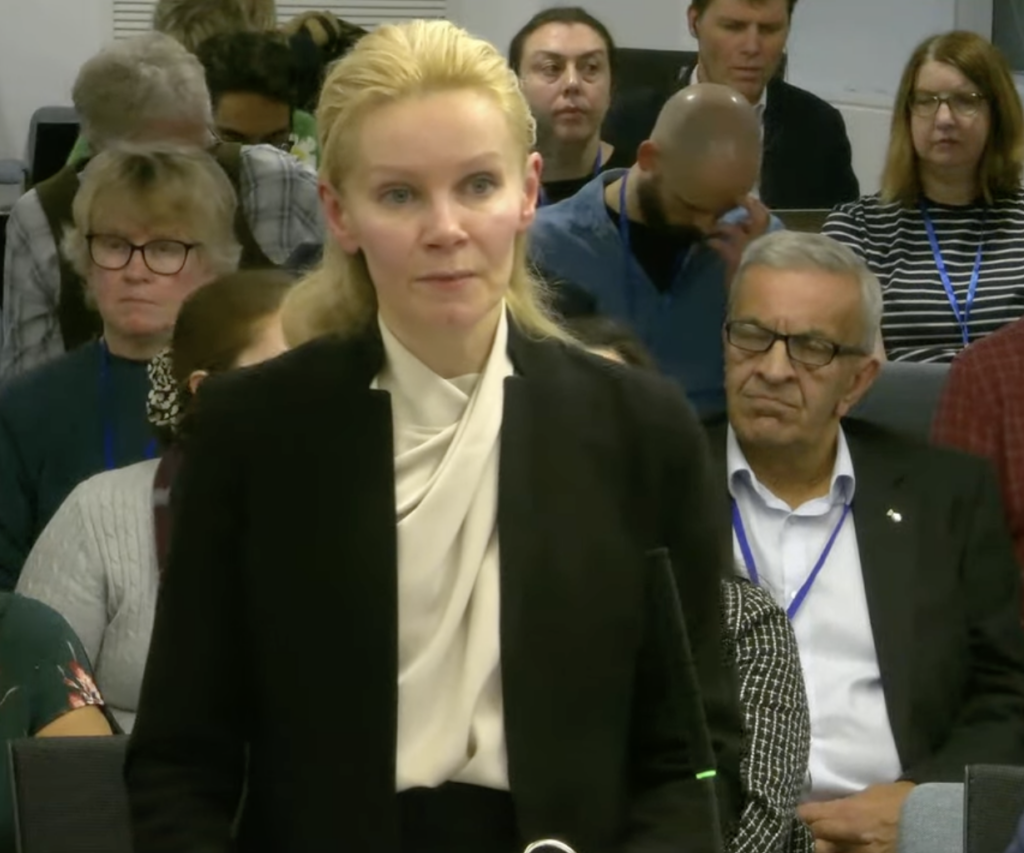
Dobbin took the judging panel (Dame Victoria Sharp and Mrs Justice Heather Williams) to several instances where the Guidance made it quite clear that deception as to sex, no matter how a suspect presented, was a potential criminal offence
Or in the precise words of the June 2026 version:
“Depending upon the circumstances of the case, a trans or non-binary person (including those who have a GRC and/or have had gender reassignment) may deceive a complainant as to their sex if they choose not to disclose that they are trans/non-binary, or if they make a deliberate false assertion or lie in respect of their sex and/or gender identity.”
What the Guidance could and should not do, said Dobbin, was describe the precise conduct or situation which could lead to a possible prosecution scenario (especially as there was no case law to lean on).
Dobbin read a couple more paragraphs to the court: “the test to be applied is whether the non-disclosure or representation is so closely connected with the sexual nature of the relevant act that it deprived the complainant of their freedom to choose whether to have sexual relations with the suspect” and “Evidence that the suspect failed to disclose their sex and/or gender identity may be
sufficient, depending on the circumstances of the case. But other evidence may be necessary.“
This was what should focus the mind of crown prosecutors, said Dobbin, and be taken into account.
Dobbin then moved on to another argument made by Sex Matters – that the guidance was so sympathetic to trans and non-binary people, prosecutors might be guided towards placing too much weight on a trans person’s unwillingness to divulge their birth sex or the fact they might truly believe they have changed sex.
She quoted another section of the Guidance which says: “even though the suspect fails to disclose their sex and/or gender identity they may reasonably believe the complainant consented due to: the degree to which the sex, trans or non-binary identity of the suspect is apparent“. Dobbin called this “common sense” – something which needs to be considered. She echoed the case of H and McNally when she brought up the example of a person using a prosthetic device as a sex aid. Dobbin said it might be an offence in itself if it’s non-consensual, but if it’s said to be a penis and it’s not – that involves deception as well and it needs to be looked at in the round by prosecutors before they come to a charging decision.
Summarising her case as to content, Dobbin said the Guidance is “oriented towards specialist prosecutors. There is no clear case law regarding gender identity. [The Guidance] says a prosecution could be brought on the basis of gender identity. It allows for a fact-sensitive assessment. It’s making clear that not disclosing your sex or gender identity might be an offence… that reflects the law as it stands in a field in which there are no bright lines and a body of law that can’t be reconciled.”
Der Vine

After a short break, Sarah Vine and Chris Knight came back with their responses. Vine started by focusing on the DPP’s reliance on the case of H as an example of where gender identity came into play.
Briefly: H persuaded Woman B that she had had a phalloplasty and therefore despite being female, H was a man capable of penetrating Woman B with her “pseudo penis”. Woman B agreed to have sex with H on that basis. H had not had a phalloplasty and penetrated Woman B with something else (the exact object is disputed). When Woman B went to the police, H eventually pleaded guilty to two counts of sexual assault (relating to cunnilingus) and one count of assault by penetration.
Firstly Vine accepted that gender reassignment surgery could be brought into play in a matter of sex by deception (as it was objectively verifiable), but then explained that the deceptions involved in H’s case were not about gender identity. The deceptions were:
– inducing Woman B into a fiction: “the lie she was in some non-corporeal way a man”
– that she “lived in a way that was consonant with that non-corporeal identity”
– that she had “undergone surgical modification” so her body resembled that of a man.
Vine said Woman B knew of H’s sex before these deceptions, therefore she knew that the two acts of cunnilingus were being “performed by a person she knew was a woman, performed precisely by the body part she was expecting in a form she was expecting. She knew she was engaging with a woman.”
Yet she was charged with sexual assault for those acts. Vine argued the deceptions being perpetrated by H were not close enough to act of oral sex to meet the criminal threshold. Gender identity was irrelevant. Consenting to be penetrated by one thing and finding yourself penetrated by another is different, but again, said Vine – this has nothing to do with gender.
Positively Hazardous Category Confusion
Whilst the ins and outs of a case which focuses on phantom surgical attachments are certainly interesting, Vine told Dame Victoria (who asked for the figure) that trans and non-binary people who have had gender reassignment surgery are just a tiny percentage of the overall trans population. It was no excuse for the CPS to be peppering its guidance with a self-reported state of being (gender identity) which can’t be reliably measured and was conflated throughout with sex. Vine said it was “positively hazardous” to introduce gender identity as a legal moving target “and to introduce it in such a way that it elides with a known quantity” – sex.
Vine drew attention to another area of the Guidance Sex Matters sees as problematic – the idea that people can present as the opposite sex without it being a conscious deception. They may actually believe they are women, despite being men. Vine said the Guidance seemed to present this as a get out, telling the court the DPP’s position “seems to suggest that a suspect does not commit a deception if that suspect’s definition of sex can be expanded to incorporate gender identity. That is a category confusion into which crown prosecutors cannot afford to fall.”
Vine said that almost every clause under the heading Trans and Non-Binary Experience in the Guidance “serves to undermine a suspect’s culpability… the tone of them is without further direction entirely consistent with a lowered culpability.”
Still Standing
Chris Knight spoke next to address the issue of standing (ie whether Sex Matters have the legitimacy to bring this judicial review). Knight addressed the Good Law Project’s failure to achieve standing in a legal challenge to the Equality and Human Rights Commission’s guidance on single-sex spaces, a matter raised by the CPS yesterday. Knight said this was a High Court decision, and there were higher authorities at the Supreme Court and Court of Appeal which fell strongly in Sex Matters’ favour. He also said that the Good Law Project asserted a universal ambition to litigate “any form of public law error” – whereas Sex Matters had a specific and dedicated area of expertise in the subject under review. “There’s no read across”, he said.
Knight then removed the issue of standing entirely when he pointed out that if Sex Matters case was strong enough to persuade the court there had been an error of law in the DPP’s Guidance, it would be against the public interest for their case to be dismissed on grounds of standing. Knight said it was open to the CPS to make the argument that if Sex Matters has no standing then whatever of the merits of its case it should fail, but he said no such point was forthcoming, as it knows such an argument is unsustainable.

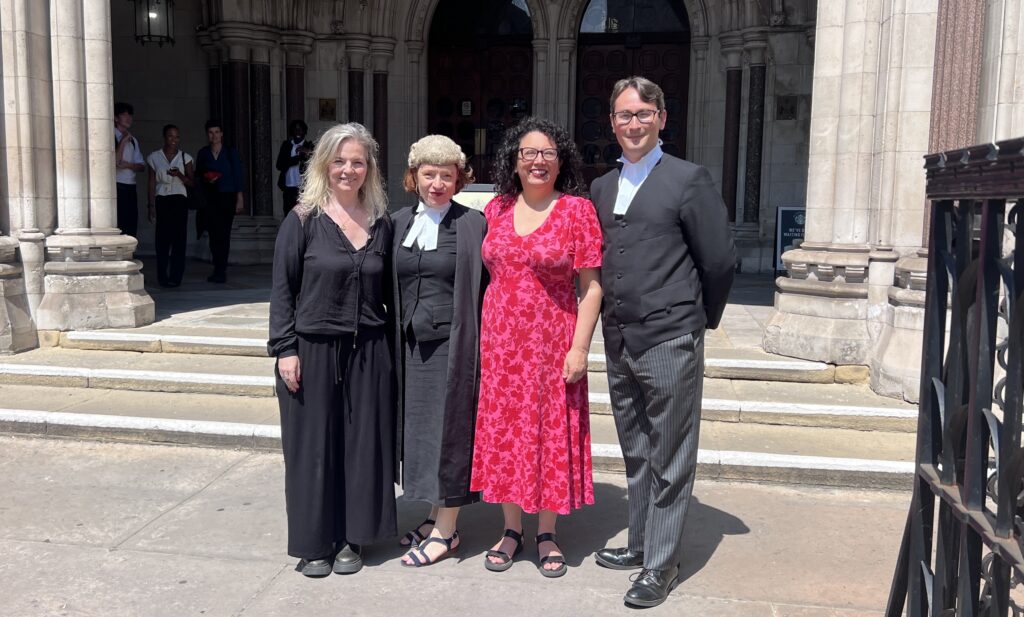
Outside court I spoke to Maya Forstater from Sex Matters. She said “it’s been over a year for us to get here. Court is the only place where you get to have the arguments laid out patiently and tested against each other. It can’t happen on social media. And it clearly doesn’t happen within a public authority. So if we have to keep dragging them to court, we will.”
Addressing the fact that this is a lot of money to spend examining a crime which has only been prosecuted three times since 2024, Forstater said “It’s about consent. And consent is at the heart of this. Recognising that other people have rights and that however much somebody believes in their gender identity, it doesn’t remove other people’s rights. When you’re consenting to have sex with someone, that is the most intimate, important place, where someone else’s consent should not be confused or overridden”.
The judgment will be published online in due course.
PS For those who keep an eye on the comings and goings of the judiciary, Dame Victoria Sharp has already announced she will be retiring as President of the Kings Bench Division. Today she told the court “this will likely be one of my final cases. It’s been a huge pleasure to hear submissions of such quality and clarity in a difficult case, raising difficult issues. The bar is in safe hands.”
My work on this website is entirely funded by donation. If you would like to make a one-off or regular monthly contribution and receive the Gender Blog newsletter and blog posts in your email inbox you can sign up here. Your email address will be stored securely and confidentially, never given to a third party and will only be used to inform you about things I think are interesting. If you have a story, please use the contact form. All messages go directly and securely to my email inbox and will be dealt with in the utmost confidence.


Leave a Reply