

Patricia Marquis, the Executive Director of the Royal College of Nursing in England is quite obviously an intelligent, personable and compassionate individual with the requisite element of corporate steel required to reach the higher echelons of large organisation. At times today she was at a loss to answer some of the questions being put to her by Sandie Peggie’s barrister, Naomi Cunningham. Not because the questions were particularly complicated, but when combined with the evidence, Marquis was forced to confront a period of time when a lot of people in civil society – particularly those in the public sector – lost their ******* minds.
Marquis was the day’s only witness, the most senior RCN employee and the last to give evidence in Peggie v RCN. Nurse Sandie Peggie has taken the RCN to an employment tribunal over its alleged failure to advise her properly and their refusal to fund a claim Peggie is running against NHS Fife over its handling of aspects of the disciplinary proceedings raised against her.
Morning Chief
The day began with Marquis’ evidence in chief. David Hay KC, the RCN’s advocate in this tribunal asked first about Marquis’ career and current role, chucked in a few of questions about the gender wars, then walked Marquis through a series of documents in the trial bundle.
We learned Marquis had been a nurse in a specialist orthopaedic unit in Oxford for ten years, a union activist, then officer, rising up through the ranks over thirty years to her current position, where she manages seven directors looking after nine regions in England. She reports directly to the RCN’s CEO Professor Nicola Ranger, she is a member of the RCN’s executive team, and like Norman Provan, she is a bit of a big deal.
Hay asked if the RCN had a position on the debate “between concepts of gender identity and biological sex”.
“We have no position on those two concepts”, stated Marquis. Nor, to the best of her knowledge, had they ever.
Hay was interested as to why the RCN flew the Progress Pride flag above its HQ. “We want to be seen to be inclusive of all of our membership” replied Marquis. “And the use of that flag is really to demonstrate that inclusivity.”
Then came the documents. Hay referred to an article called “Care for trans patients: what nursing staff need to know”, which was published in the RCN Magazine in 2022. The article quotes a clinical nurse specialist called Liz who works in a gender clinic, who describes the importance of “reform” to the NHS system “to improve early diagnosis of gender dysphoria, with easier access to HRT and blockers.”
Hay wondered if this was a statement of policy. It wasn’t, confirmed Marquis. Neither was the RCN document “Fair Care For Trans Patients“, produced in 2017, which instructed nurses assigning patients to male or female wards that “Patient placement should be based on both asking the patient for their preference, and on gender presentation.”
Despite being RCN-endorsed guidance it was, according to Marquis, “peoples choice to engage with the content or not”. The (now withdrawn) document was simply there “to help people understand different areas of clinical care”. It has not been replaced because the guidance on trans patients was still “a work in progress” since the Supreme Court ruling on sex in April 2025.
As Hay took Marquis through the documents she was allowed to explain her approach to the gender wars being one of “balance”, whilst suggesting it was a “difficult and complex” area to navigate.
As he had done with other witnesses, Hay raised one the issue of when the RCN would offer legal assistance to members – and Marquis was clear if a member had gone “quite a long way down the road with that legal advice then even if they say that they would stop, we would still maintain the position of not picking someone’s case up mid way.”
Finally, Hay asked about the RCN event Freda Wallace attended and then posted about on BlueSky (see below and yesterday’s report). Marquis was keen to stress Wallace was at “an event for any member to attend to talk about inclusion” and anyone who wanted to do could speak. “The day was more like a workshop”, she said. “I don’t think they were invited speakers.”
Getting Crossed
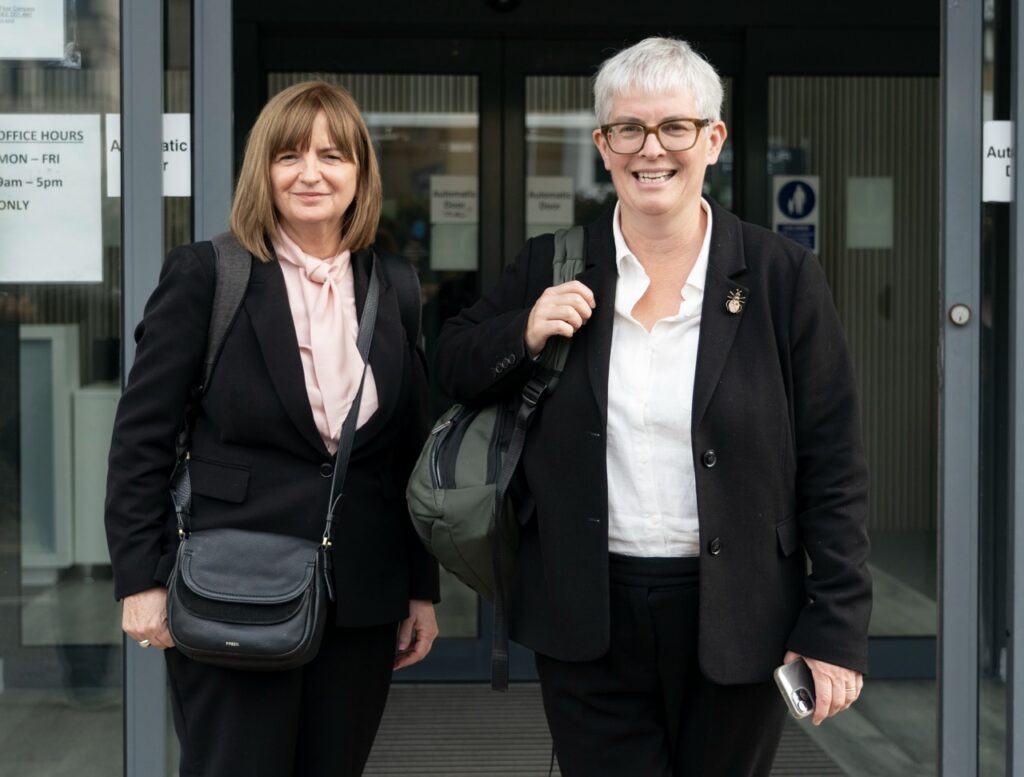
The next four hours were given over to Naomi Cunningham’s cross-examination. This is a curation of most, but not all of it. If you want the whole thing – you can read it here.
The first thing Cunningham pointed out was that despite the RCN’s oft-stated commitment to Equality, Diversity and Inclusion, it didn’t know how many actual women and actual men it has as members (because it didn’t record their biological sex), nor did it know how many of its members might hold gender critical views, because it never asked them. Marquis acknowledged this but said things had now changed, as of July, members were being asked about their philosophical beliefs.
“Is that a bit of learning from these proceedings?” asked Cunningham, cheekily.
“No”, sniffed Marquis. “It was already in our EDI strategy as an area we needed to improve.”
Cunningham reminded Marquis of a comment she made in her evidence in chief about the RCN’s 600,000 strong membership being “reflective of society”. Cunningham took Marquis to a YouGov survey which showed 60% of people across Britain were against allowing males, however they present, into female changing rooms. Apart from 18-24s, this was a majority view across every listed category, “even the Lib Dems”.
Given the RCN was “reflective of society”, asked Cunningham “can you agree that it is a safe bet that a significant proportion of members think that trans-identifying men shouldn’t be allowed to use women’s changing rooms?”
After a bit of wriggling, with the help of the judge (“there was a yes”), Marquis conceded there was likely a “broad range” of members who held that same view.
Cunningham mentioned a devastating report by Bruce Carr KC, which found misogyny running deep within the RCN. Cunningham said Carr found there was a “tendency for male voices to shout down female voices”, that “sexual exploitation” appeared to be rife at Congress and discrimination against women was alive and well. Cunningham then took her to the RCN’s EDI strategy, published in 2024. “The document barely even mentions sex at all, does it?”, she asked.
Marquis protested that there was a completely separate workstream on issues arising from the Carr report which was undertaken before the 2024 EDI strategy was published. “Are you telling the tribunal”, started Cunningham, “that by the time the EDI strategy was drafted, you’d finished dealing with sex discrimination so you didn’t need to mention it in your strategy?!”
“No”, replied Marquis, “I am saying it was still an issue and to some extent is still an issue that we continue to address.”
Furries and Paedophiles
Cunningham took Marquis to a RCN Magazine article about the For Women Scotland Supreme Court judgment. In it, Marquis is quoted as saying “we know this judgement has caused upset, worry, confusion and concern for many of our members. Let me be clear – the RCN stands in support with our LGBTQ IA+ members. We’ve heard from members that it’s led to lots of negativity towards trans people and some feel very unsafe. This is unacceptable.”
Cunningham wondered if Marquis could put a word to the letters in LGBTQIA+. Marquis got as far as “I” but failed at “A”. Cunningham asked if she knew what the “+” stood for. Marquis wasn’t sure. Cunningham told her it could mean furries or adult babies and that having the RCN “standing for a group whose parameters you can’t” was surely “worrisome”?Marquis agreed.
“Worrying and dangerous”, suggested Cunningham “because it may turn out that the plus has you expressing support for furries, adult babies, paedophiles…”
“That’s a judgment I’m not going to comment on in terms of people’s choices,” replied Marquis, possibly not quite clocking that Cunningham had said paedophiles.
Marquis then admitted she hadn’t written the passage anyway – it was written by her comms team. She just signed it off.
Pronouns in Bio

Patricia Marquis has pronouns in her LinkedIn bio. She accepted most people would “assume” it was obvious she was a woman. So why did she need pronouns in her bio? Cunningham suggested this was signalling her fealty to gender ideology, which Marquis had claimed to have no view on. Marquis disagreed.
Cunningham pushed her. “By declaring your own pronouns what you are doing is signing up publicly to the idea that pronouns shouldn’t be determined by someone’s sex but their gender identity which only he or she could know.” Why else have them? “You’re not trans, are you?”
“No”, said Marquis.
“Obviously not”, said Cunningham.
It wasn’t not so much about people addressing Marquis, she conceded, but to allow people whose presentation isn’t “necessarily clear” to feel comfortable to do the same.
This was precisely what Cunningham meant – Marquis was providing “cover” for people who wanted to “tell people which pronouns to use”.
Marquis said it was just about helping people “live comfortably with themselves and with other people.”
Cunningham noted Jemma Sheppard, the Anderson Strathern lawyer who acts for RCN members in Scotland (as well as the RCN in these proceedings) had pronouns in her email signature.
“If one of your members is lucky to get past the gatekeeping process and gets referred to a solicitor, the next thing they are likely to see is a solicitor performing her own commitment to gender ideology… if the member is in difficulty because of her gender critical belief or has been accused of misgendering… it is not going to make her feel comfortable, is it?”
“I understand that proposition” replied Marquis, “and I can see where that comes from, but equally we have a lot of trans members for where the opposite would be true, so I think it is still a contested space.”
Any Philosophical Belief Tat You Want, So Long As It’s Gender Identity Ideology
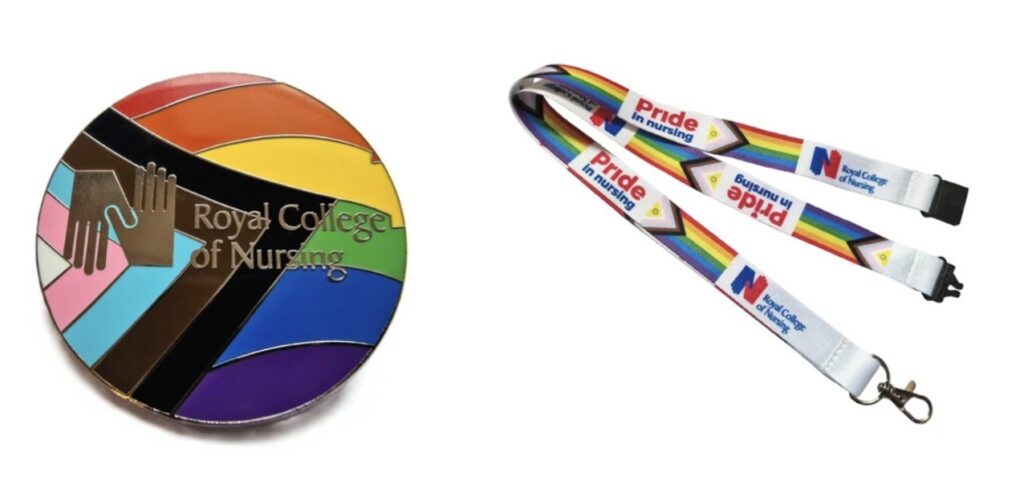
For the third time during this tribunal, the RCN gift shop had its doors opened by Cunningham. As with Norman Provan and Gillian Tate, Marquis was forced to concede that the philosophical belief in gender ideology was the only belief represented in the 57 pages worth of “tat”.
Despite once again agreeing that the RCN held gender critical beliefs in exactly the same regard as gender ideology, Marquis refused to say if the RCN shop could or should stock enamel badges in suffragette colours (which are used by GC campaigners) carrying the RCN logo.
“I don’t know.” she said. “It would have to be considered”.
Cunningham asked what good reason could there be for not carrying GC merch?
Marquis seemed to snap back at the barrister. “I can’t answer the question.”
“What’s hard about it?” asked Cunningham, a little laconically.
“It’s not my area of expertise, and I can’t answer the question”, said the exec, who seemed momentarily very unhappy.
Everyone Else Is Doing It, So Why Can’t We?
In what was perhaps the most bizarre and revealing series of exchanges, Cunningham brought up the 2017 Fair Care for Trans Patients RCN guidance document again. The following passage was read out once more:
“Where trans patients are cared for in an inpatient setting, care should be taken to meet their needs for privacy and dignity whilst an inpatient. Patient placement should be based on both asking the patient for their preference, and on gender presentation.”
Cunningham said the RCN knew self-ID was “bitterly contested” by sex realists, yet the union had adopted it as best practice, without any form of consultation or debate.
Marquis agreed that self-ID was “contested”, but “the normal and accepted practice, for a number of years, under the law, until it was clarified, was as it is described in this document.”
“What you are saying is that gender ideology had been accepted across the NHS and you weren’t an outlier”, replied Cunningham. That’s absolutely true. The NHS had accepted gender ideology, as had the trades union movement and the public sector, but it still doesn’t mean you haven’t adopted it.”
Marquis tried to disagree, saying that the RCN was just trying to “follow the law at the time, and the practice at the time”. After pointing out it was never the law and the Supreme Court judgment only explained what the law always has been, Cunningham reiterated her point – the RCN had “picked a side” and “just because everyone else was doing it didn’t mean you weren’t picking a side.”
“I’m not sure I see it as picking a side”, replied Marquis. “I see the argument being made about respecting people’s individual choices.”
So… So… Complex…
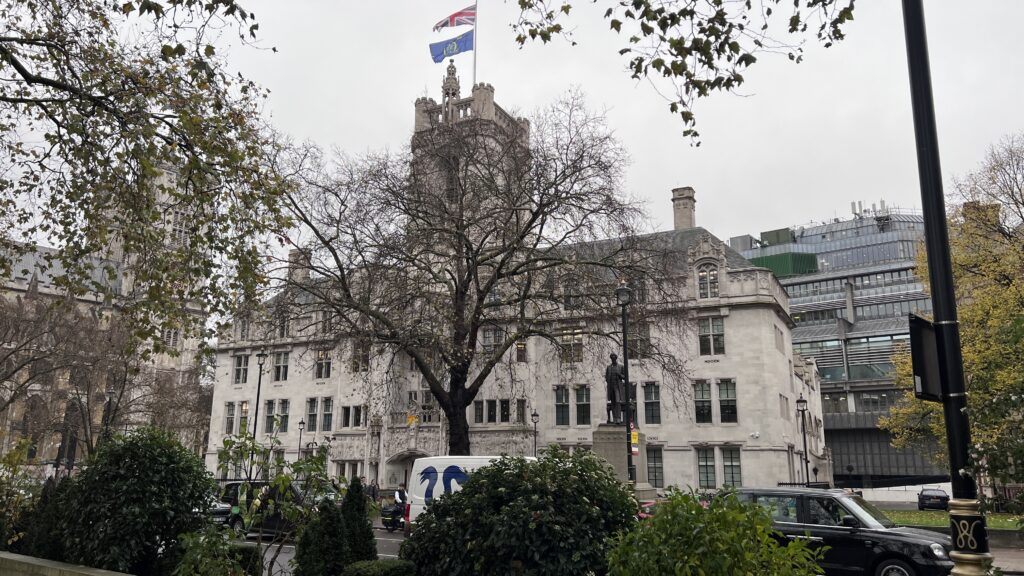
On we went to a lengthy period spent discussing about the apparent problems caused by the Supreme Court’s ruling for healthcare providers. This revealed the RCN’s institutional paralysis. Marquis was clear that as an organisation it was uninterested in taking a lead on setting out hard rules for best practice in care settings. It had instead decided to lobby the Nursing and Midwifery Council, NHS England and the Equality and Human Rights Commission to come up with guidance. This, of course, leaves its frontline members in a poke, requiring them to do precisely what Marquis says she doesn’t want them to do – try keep everyone happy in potentially stressful (and urgent) situations whilst making potentially unlawful choices about who gets assigned to which ward.
Cunningham suggested the delay and prevarication was a direct result of people “horrified” by the SC who “got to work trying to generate confusion” about what it meant for people.
“I guess people who were unhappy with the judgment have been looking at ways they can challenge it” said Marquis.
Cunningham compared all the handwringing over how best to balance the rights and needs of people with the protected characteristic of gender reassignment with the decision to let any old bloke use the women’s changing rooms and be treated in female wards. Cunningham asked what steps the RCN took on behalf of its female membership to make sure “that change” was handled sensitively.
“I don’t know when that change happened. And I don’t know the answer”, said Marquis, who was very definitely there at the time.
“The truth is,” said Cunningham, “nothing was done. Neither unions nor employers asked women what they thought.”
“I don’t know,” repeated Marquis, helplessly.
Cunningham turned to the Supreme Court engagement sessions which were held last year in the light of the Supreme Court ruling. We have already heard in this tribunal that two online sessions descended into farce with each of them being dominated by abusive trans-identifying men one of whom was allowed to give full vent to his emotions and another who suggested gender critical women were bigots and racists. It transpired today that the RCN had held two other secret separate meetings for trans activists and gender critical women. The latter was so secret it was by invite only. Two women turned up. Cunningham suggested that the reason it was kept secret was because the RCN was terrified of the backlash it would get from the trans activists within and without its organisation if it told anyone the meeting was happening. “All hell would have broken loose”, suggested Cunningham.
“I’m not aware that that’s a concern we had, no.” said Marquis, but she couldn’t or didn’t explain why RCN kept it so quiet virtually no one turned up.
Wallace and Vomit
We then got a bit more context on the tweets RCN member Freda Wallace had posted. Marquis was invited to look at the photo of a semi-naked Wallace in fetish gear receiving oral sex. Cunningham told Marquis that Wallace had posted this photo, tagging in a gender critical disabled woman whose disability partially informed her position because her disability meant she required intimate personal care. Cunningham also pointed to posts in which Wallace had called a gender critical campaigner a “joyless little cunt” and described himself as a “fetishist” and “pervert”. She told Marquis that the RCN’s solicitors had been in possession of this information since 30 July, but it appears nothing had been done.
“I’m not sure what you’re expecting us to do about it”, said Marquis.
Cunningham drew her attention to the RCN code of conduct which states “Members must conduct themselves so as to maintain the individual and collective reputation of the RCN and its members” and “Members are expected to maintain a high standard of personal conduct and to treat staff and other members with respect.”
Marquis said the RCN was not about “policing” members’ behaviours.
Cunningham pointed out that Wallace had access to the RCN’s HQ and knowing what was now known about him – some members might not be “comfortable” around him.
Marquis agreed that some members might not be comfortable around Wallace, but it was not up to the RCN to “make judgments about what is right and wrong. That is not our role, except there are circumstances where it is, but it is not in these circumstances.”
This went back and forth a for a bit until Cunningham found herself asking if there was “anything a member could do in their public life that would be sufficiently bad behaviour to take steps to expel them?”
Marquis eventually conceded it was “a very interesting point that we’ve never really debated in the way it is being raised today.”
A Leer From A Rose
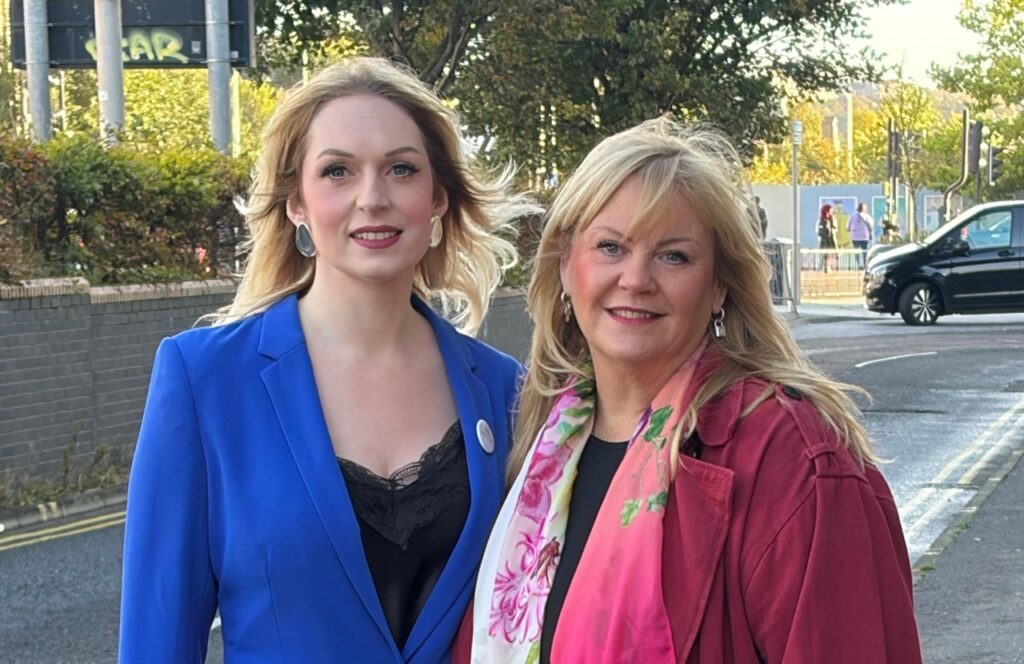
Towards the end of the cross-examination, Cunningham took Marquis to a letter from Bethany Hutchison (and witness for Sandie Peggie) who wrote to the RCN explaining the Darlington Nurses’ decision to form a union. The letter set out what had been going on:
“Since around August 2023,” wrote Hutchison, “our changing room has been frequented by a biological male who identifies as transgender and is known as ‘Rose’. That individual has told colleagues that he had previously been taking cross-sex hormones but then stopped doing that as he is trying to get his girlfriend pregnant. In other words, he has chosen to make it known at work that he is a sexually active biological male. He dresses in male clothes and has facial hair. His behaviour when visiting the female changing room has been found disturbing by many nurses, eg. he spends long times unnecessarily hanging about the changing room, often wearing nothing except men’s fitted boxer shorts, seeking to initiate conversations with female colleagues, including those with whom he is not acquainted, while they are changing; and/or staring at us, in particular at breast area, as we are getting changed. One of our members, who is a survivor of child sexual abuse and therefore particularly vulnerable, has experienced particularly egregious harassment by ‘Rose’ who approached our member while she was alone in the changing room and persistently urged her to change clothes in his presence. Because of such experiences and the ongoing danger of similar experiences, many nurses regularly have to change clothes in unsuitable locations such as toilets or shower cubicles. Many nurses have repeatedly raised those concerns with the management since August 2023… On each occasion, the management’s response was dismissive and often threatening. The management told us that that, rather than being protected from having to undress in front of a man, we needed to be “educated” so as to “broaden our mindset” and become “more inclusive”. We were repeatedly criticised for daring to raise our concerns and threatened with disciplinary action.“
Cunningham invited Marquis to agree that if what Hutchison was saying was true, ‘Rose’ was engaging in “shockingly abusive” behaviour. Marquis said it was “certainly not a situation that would be comfortable”. After several more goes, Cunningham managed to get Marquis to concede that if what Hutchison was saying was true, it was “shockingly abusive”. Cunningham suggested her reluctance to concede this demonstrated the grip gender ideology had on the RCN.
You Can Come Out Now

Cunningham showed Marquis the website search she showed Gillian Tate yesterday revealing that the word transgender appeared 170 times on the RCN website, the letters LBGTIA appeared sixty times and “gender critical” just twice.
Marquis agreed this was “disappointing” whilst at the same time insisting “we are as interested in the rights of people who are gender critical as we are about trans members and trans people”. They just don’t write much about them on their website.
The RCN’s response to the Forstater ruling was also brought up again. Marquis accepted it was “shocking” there appeared to have been no legal training on its implications. Cunningham showed her the RCN website article on it which states:
“it does not mean that trans people are not protected… it does not mean those with gender critical views can misgender trans people with impunity and it does not mean that employers will not be able to provide a safe environment for trans people.”
Cunningham suggested the comment was entirely framed as being about trans people rather than an opportunity to say to gender critical female and male members: “You can come out now. It’s safe. You can say that sex is real and it matters, and it matters in a clinical setting, and you are protected.”
Marquis agreed that it did not say so using those words, but the article did note that gender critical beliefs were henceforth protected.
With other RCN witnesses, Cunningham had argued that the RCN was so deeply in the grip of gender ideology it didn’t realise it was discriminating against its gender critical members. As per the other RCN witnesses, Marquis rejected that analysis.
Today Cunningham brought out another point. Even as the RCN begins to show signs of institutional self-awareness, acknowledging it has a duty to help its gender critical members, it is prevented from moving beyond the grip of gender ideology by fear. Fear of opprobrium, fear of trans activists, fear of how they might target and attack any part of the organisation that dares to break cover, go public, acknowledge or even celebrate their gender critical members.
Marquis disagreed.
Peggie v RCN preview interview
Peggie v RCN Day 1: Getting Taken Seriously
Peggie v RCN Day 2: Trans-Organisational Madness
Peggie v RCN Day 3: unProvan
Peggie v RCN Day 4 Pt 1: Nurses Assemble
Peggie v RCN Day 4 Pt 2: Stuart Fraser
Day 1 Live Tweets Collated
Day 2 Live Tweets Collated
Day 3 Live Tweets Collated
Day 4 Live Tweets Collated
Day 5 Live Tweets Collated
Day 6 Live Tweets Collated
Fair Care For Trans Patients 2nd Edition – RCN
Let’s talk… inclusion: Being the Change – RCN
Thanks to everyone who has contributed to help fund my reporting of this court case. I am live-tweeting each day in court and publishing reports after each day’s proceedings. Subscribers get a special subscriber-only newsletter after each day’s hearing (once I’ve got a report up on the website).
If you would like to receive the GenderBlog newsletter and blog posts in your email inbox for a small monthly or one-off donation you can sign up here. Your email address will be stored securely and confidentially, never given to a third party and will only be used to inform you about things I think are interesting. If you have a story, please use the contact form. All messages go directly and securely to my email inbox and will be dealt with in the utmost confidence.


Leave a Reply